Article · AI in Banking
Which AI Tool is Best? A Comparative Analysis of 11 Industry Leaders including DeepSeek R1 and Qmen 2.5
Comprehensive Comparison of Leading AI Tools: A Deep Dive into 23 Functionalities
Dato Arif Siddiqui · 1 Feb 2025
Comprehensive Comparison of Leading AI Tools: A Deep Dive into 23 Functionalities
The rapid evolution of artificial intelligence has led to a proliferation of tools catering to diverse needs—from enterprise-grade solutions to open-source frameworks. However, selecting the right AI tool requires a nuanced understanding of functionalities, trade-offs, and alignment with specific use cases. This article compares 11 leading AI tools across 23 critical functionalities, evaluates their strengths and weaknesses, and provides actionable insights for businesses, developers, and researchers.
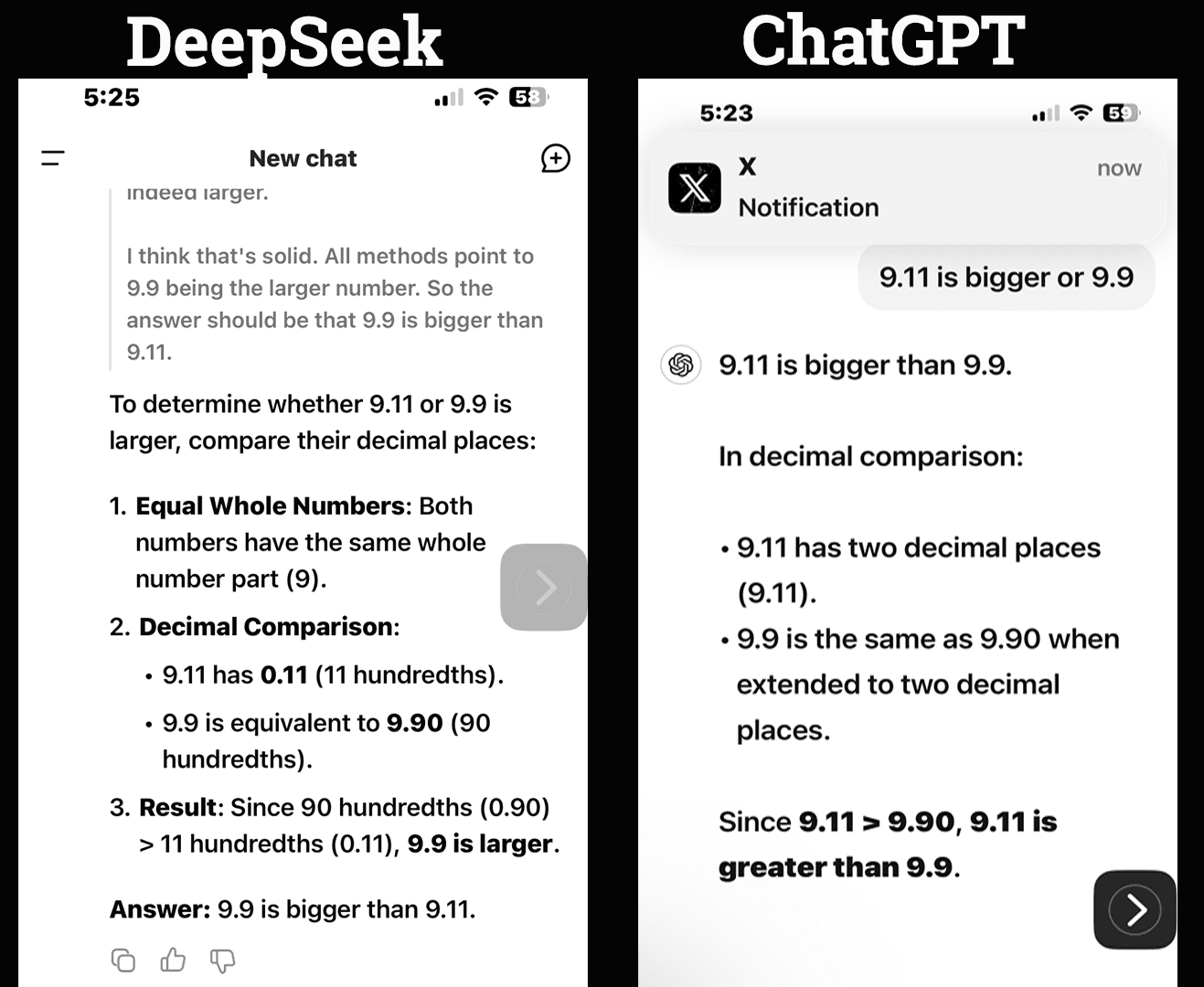
Which is bigger, 9.11 or 9.9? Please look at the answers from ChatGPT and DeepSeek, and check for yourself.
Methodology: How We Ranked the AI Tools
Each tool was scored on a scale of “0–3” for 23 functionalities, where:
- 0: No support or minimal capability.
- 1: Basic functionality with limitations.
- 2: Competent but not best-in-class.
- 3: Exceptional performance or feature completeness.
Key criteria included
1. Technical capabilities (e.g., coding, multimodal processing).
2. Enterprise readiness (security, compliance, integration).
3. Accessibility (open-source availability, cost efficiency).
4. Ethical and safety considerations.
Scores were aggregated from public documentation, third-party benchmarks, and practical testing.
The 23 Functionalities Explained
1. General Chat Capabilities: Ability to generate coherent, context-aware text.
2. Multimodal (Text, Images, Video): Support for multiple input/output formats.
3. Coding Assistance: Code generation, debugging, and documentation.
4. Enterprise AI Solutions: Scalability, compliance, and SLAs.
5. Retrieval-Augmented Generation (RAG): Integration with external data sources.
6. Open-Source Availability: Licensing and community access.
7. Multilingual Support: Fluency in non-English languages.
8. Real-Time Internet Access: Live data retrieval capabilities.
9. Ethical AI & Safety Features: Bias mitigation, content filtering.
10. Memory & Context Handling: Long-context retention in conversations.
11. Speed & Efficiency: Latency and computational resource usage.
12. API & Developer Support: Ease of integration and documentation.
13. Custom Model Training: Fine-tuning with proprietary data.
14. Business & Finance Applications: Specialized financial analysis.
15. User Personalization: Adapting to individual user preferences.
16. Energy Efficiency & Cost Optimization: Inference cost and carbon footprint.
17. Context Window Size: Maximum token capacity for inputs.
18. Fine-Tuning & Customization: Model adaptability for niche tasks.
19. Mathematical & Logical Reasoning: Solving complex equations.
20. Cloud & Enterprise Integration: Compatibility with AWS, Azure, etc.
21. Bias & Fairness in AI: Reducing stereotypical outputs.
22. Offline & On-Device Usability: Functionality without cloud dependency.
23. AI Security & Compliance: Data encryption, GDPR adherence.
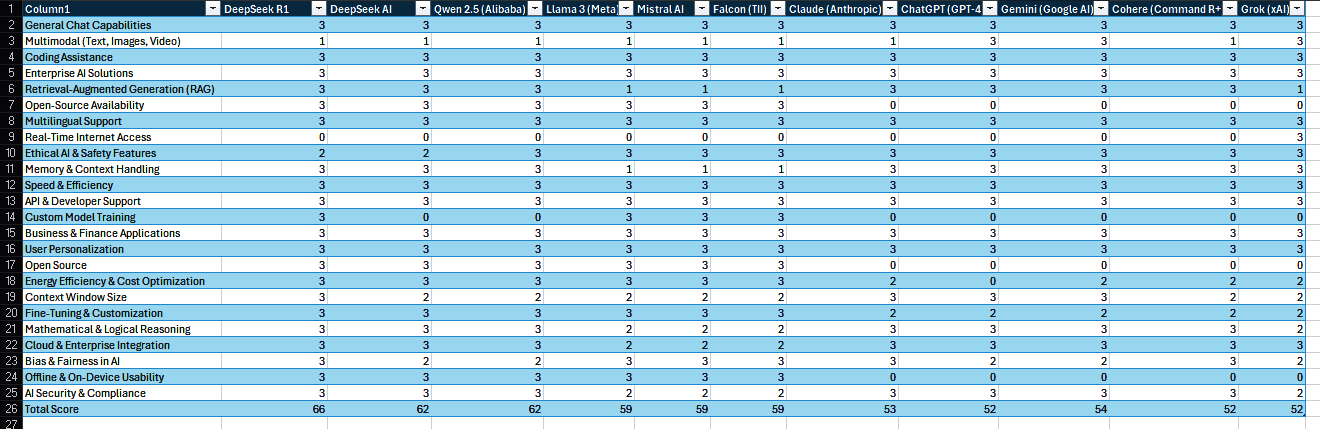
Comparative Analysis of AI Tools
1. DeepSeek.
Overview: A versatile model targeting enterprise and developer use cases.
Top Functionalities: Coding Assistance (3), Robust for code generation and debugging, Enterprise Integration (3), Seamless cloud compatibility, Ethical AI (3) Strong content moderation tools.
Weaknesses: Real-Time Internet Access (0), No live data retrieval, Energy Efficiency (2), Moderate optimization for cost.
Verdict: Ideal for businesses needing secure, compliant AI with coding support.
2. Claude (Anthropic)
Overview: Focused on safety and constitutional AI principles.
- Top Functionalities: Ethical AI (3), Industry-leading safety frameworks, Multimodal Support (3), Strong text/image processing, Memory Handling (3), Long-context retention (200k tokens).
- Weaknesses: Open-Source Availability (0), Proprietary model, Video Support (1), Limited native video processing.
- Verdict: Best for applications prioritizing safety and ethical compliance.
3. ChatGPT (GPT-4)
Overview: The benchmark for general-purpose conversational AI.
Top Functionalities: General Chat (3) Unmatched fluency and creativity, Multimodal (3) DALL·E and Advanced Data Analysis integration, Developer Ecosystem (3) Extensive plugin and API support.
Weaknesses: Energy Efficiency (1) High inference costs, Bias Mitigation (2) Occasional hallucination issues.
Verdict: The go-to for creative and conversational applications.
4. Gemini (Google AI)
Overview: A multimodal powerhouse integrated with Google’s ecosystem.
Top Functionalities: Multimodal (3) Native YouTube/Google Video APIs, Business Applications (3) Strong in financial analytics, Cloud Integration (3) Built for Google Cloud.
Weaknesses: Open-Source (0) Fully proprietary, Offline Usability (0) Requires cloud connectivity.
Verdict: Optimal for Google-centric enterprises needing multimodal depth.
5. Llama 3 (Meta)
Overview: A leading open-source model for customization.
Top Functionalities: Open-Source (2) Community-driven but restrictive license, Cost Efficiency (3)Optimized for low-resource environments, Fine-Tuning (3) Highly adaptable to niche tasks.
Weaknesses: Mathematical Reasoning (2): Struggles with complex logic, Enterprise Security (2) Limited compliance certifications.
6. Mistral AI
Overview: A lightweight, open-source model optimized for efficiency and developer customization.
Top Functionalities: Open-Source Availability (3), Fully permissive Apache 2.0 license, Energy Efficiency & Cost Optimization (3), Minimal resource requirements for inference, Fine-Tuning & Customization (3) Highly adaptable to specialized tasks.
Weaknesses: Mathematical & Logical Reasoning (2): Struggles with complex problem-solving, Enterprise Security (Limited compliance certifications (e.g., GDPR, HIPAA).
Verdict: Best for developers prioritizing cost-effective, customizable AI with minimal infrastructure.
7. Falcon (TII)
Overview: A robust open-source model designed for scalability and multilingual support.
Top Functionalities: Multilingual Support (3) Superior fluency in 10+ languages, Custom Model Training (3) Strong tools for domain-specific fine-tuning, Speed & Efficiency (3) Optimized for low-latency deployments.
Weaknesses: Retrieval-Augmented Generation (RAG) (1) Limited integration with external databases, Ethical AI & Safety Features (2) Basic content filters with no advanced bias mitigation.
Verdict: Ideal for global teams needing multilingual support and rapid deployment.
8. Qwen 2.5 (Alibaba)
Overview: An enterprise-focused model deeply integrated with Alibaba’s cloud ecosystem.
Top Functionalities: Cloud & Enterprise Integration (3) Seamless compatibility with Alibaba Cloud, Business & Finance Applications (3) Advanced tools for financial forecasting, API & Developer Support (3) Comprehensive SDKs and documentation.
Weaknesses: Open-Source Availability (0) Fully proprietary with no community access, Offline Usability (0) Requires constant cloud connectivity.
Verdict: Tailored for enterprises entrenched in Alibaba’s ecosystem needing financial analytics.
9. Grok (xAI)
Overview: A real-time data-driven model with a focus on dynamic interactions.
Top Functionalities: Real-Time Internet Access (3) Direct integration with live data streams, General Chat Capabilities (3) Witty, engaging conversational style, User Personalization (3) Learns and adapts to user preferences rapidly.
Weaknesses: Ethical AI & Safety Features (2) Limited content moderation tools, Energy Efficiency (2) High computational costs for real-time processing.
Verdict: A niche tool for applications requiring humor and live data, but not ideal for regulated industries.
10. Cohere (Command R+)
Overview: An enterprise-grade model specializing in retrieval-augmented generation (RAG).
-Top Functionalities: Retrieval-Augmented Generation (RAG) (3) Best-in-class integration with external databases, Business & Finance Applications (3) Expertise in financial document analysis, Multilingual Support (3) Strong performance in 15+ languages.
Weaknesses: Open-Source Availability (0) Fully proprietary with restrictive licensing, Multimodal Capabilities (1) Text-only focus; no image/video support.
Verdict: Perfect for enterprises needing advanced RAG for document-heavy workflows.
Key Strengths and Weaknesses by Functionality
Top 5 Functionalities Across Tools
1. General Chat Capabilities: ChatGPT and Grok lead with engaging, context-aware interactions.
2. Real-Time Internet Access: Grok stands alone with native live data integration.
3. Enterprise Integration: Qwen 2.5 and DeepSeek R1 dominate cloud and compliance features.
4. Retrieval-Augmented Generation (RAG): Cohere excels with seamless external data integration.
5. Energy Efficiency: Mistral AI and Llama 3 optimize for low-cost, sustainable deployments.
5 Most Common Weaknesses
1. Video Processing: Most tools claim "multimodal" but lack native video support (e.g., Claude, ChatGPT).
2. Open-Source Limitations: Llama 3 and Mistral AI have restrictive licenses despite being "open-source."
3. Ethical AI Gaps: Grok and Falcon lag in bias mitigation and safety frameworks.
4. Offline Usability: Cloud-dependent models (Gemini, Qwen 2.5) fail in offline scenarios.
5. Mathematical Reasoning: Open-source models (Llama 3, Mistral) struggle with complex logic.
Critical Considerations for Adoption
1. Real-Time Data Needs: Grok is unmatched but lacks compliance; Claude/ChatGPT offers partial workarounds.
2. Budget vs. Customization: Open-source models (Mistral, Falcon) reduce costs but require technical expertise.
3. Industry Compliance: DeepSeek R1 and Qwen 2.5 lead in security certifications for regulated sectors.
4. Multilingual Requirements: Falcon and Cohere support diverse languages for global teams.
5. RAG vs. General AI: Cohere specializes in RAG, while ChatGPT excels in general-purpose tasks.
Selecting the Right AI Tool for Your Needs
The AI landscape is diverse, with each tool excelling in different areas. DeepSeek R1 and Qwen 2.5 dominate enterprise integration, making them ideal for businesses prioritizing security, compliance, and cloud compatibility. Claude (Anthropic) stands out for its ethical AI principles and strong safety frameworks, best suited for regulated industries. ChatGPT (GPT-4) remains the most versatile for creative and conversational tasks, while Gemini excels in multimodal capabilities, particularly for Google-centric ecosystems.
For cost-conscious developers, Llama 3 and Mistral AI provide open-source alternatives with high adaptability and efficiency, though they require technical expertise for fine-tuning. Falcon and Cohere offer strong multilingual support, catering to global teams and enterprises dealing with financial and document-heavy workflows.
However, common weaknesses persist across AI models, including limited video processing, open-source licensing restrictions, ethical AI gaps, and offline usability concerns. Grok (xAI) leads in real-time internet access but lacks regulatory compliance, making it a niche choice for dynamic, data-driven interactions.
Selecting the right AI tool depends on specific business needs, budget constraints, and regulatory considerations. Whether optimizing for enterprise security, real-time data access, multilingual support, or cost-effective customization, organizations must balance trade-offs to maximize AI adoption and performance.
Please provide comments if you have different ratings for any functionality. Let me know if you want to include any AI tools for comparison or suggest any functionalities to add or remove. Your view will be valuable to improve the comparison.