
Article · AI in Banking
When AI Starts Trading
From algorithms that execute rules to agents that research, reason, decide and trade
Dato Arif Siddiqui · 23 Sept 2026
From algorithms that execute rules to agents that research, reason, decide and trade
It is 3:14 a.m. and you are asleep. A piece of software you authorised last week has just read an earnings release, compared it with the company's last three filings, checked your position limits and sold part of your holding. When you wake up, the trade is done and a short note explains why.
This is no longer a thought experiment.
For decades, technology has changed how markets trade. Electronic markets replaced much of the trading floor. Algorithms automated execution. High-frequency systems pushed decisions into microseconds. Now another shift is beginning:
AI is moving from explaining markets to acting inside them.
In a recent Moonshots discussion, Robinhood CEO Vlad Tenev spoke about AI agents entering trading. The important idea is not another chatbot for investors. It is the possibility that an investor can give an AI agent a goal, access to market information and permission to act.
Robinhood launched Agentic Trading in May 2026. Within the first few weeks, Tenev reported more than 50,000 agentic accounts. By the time of its second-quarter results, Robinhood said nearly 100,000 customers had opened Agentic Trading accounts, holding more than $100 million in assets under custody. Customers can trade equities, options and crypto through AI-powered agents.

That makes agentic trading more than a laboratory concept. It is becoming a real financial product, and a fast-growing one.
KEY TAKEAWAYS
■ Trading AI is shifting from advice to action: agents can now research, decide and execute within limits a human set.
■ Brokers are choosing different levels of control, from human approval on every order to bounded autonomy in ring-fenced accounts.
■ The research evidence is still thin. Sounding intelligent is not the same as making money after costs.
■ One agent is an investor problem. Millions of similar agents could become a market-structure problem.
■ Banks and brokers will need to know not only their customer, but their customer's agent.
From Algorithmic Trading to Agentic Trading
Traditional algorithmic trading starts with rules created in advance. A developer or trader defines the strategy. Software watches the market and executes when those conditions are met.
RULE → TRIGGER → TRADE
Agentic trading changes the model. The human defines an objective and constraints. The agent then collects information, reasons about it, creates a plan, uses external tools, executes permitted actions, monitors the result and adapts.
GOAL → OBSERVE → RESEARCH → REASON → PLAN → TRADE → MONITOR → ADAPT
A simple analogy helps. An algorithm is like cruise control: it holds the speed you set and does nothing else. An agent is more like handing the keys to a driver, with a destination and a speed limit. The driver chooses the route. That is far more capable, and it requires far more trust.
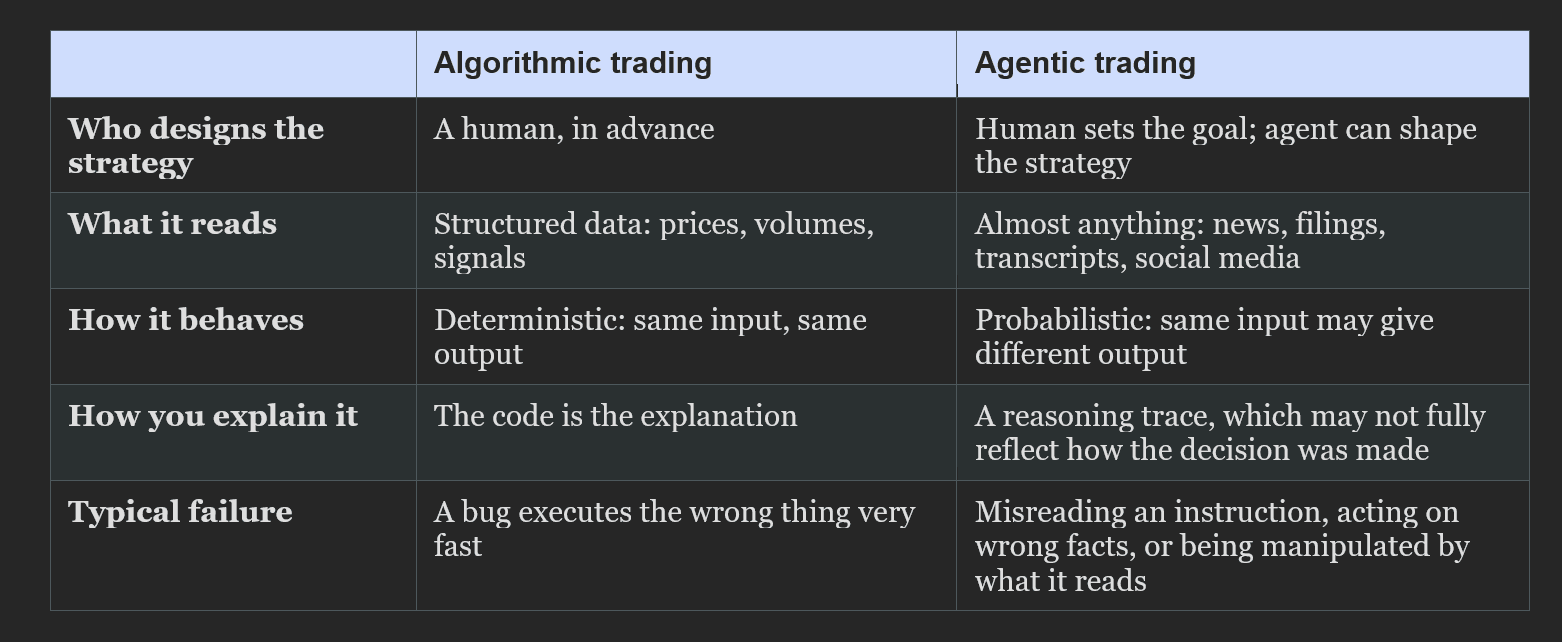
The distinction is important: algorithmic trading automates a strategy. Agentic trading can automate parts of the process that creates, evaluates and executes the strategy.
What Robinhood Is Doing
Robinhood has created an AI-native connection using Model Context Protocol, or MCP. MCP is an open standard that allows an AI system to connect with external applications and tools, a kind of universal adapter between AI models and the services they use.
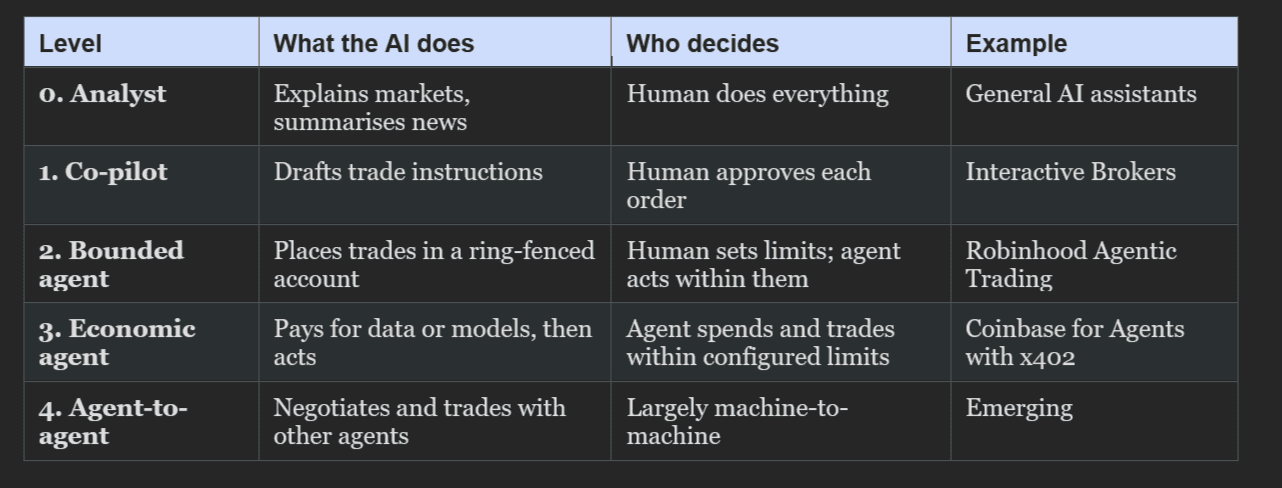
A third-party AI agent can connect to a dedicated Robinhood Agentic Trading account. The customer funds that account separately, and the agent can inspect authorized account information and place supported orders only there. This creates a bounded environment for agent activity, separate from the customer's main brokerage account.
Robinhood has added several guardrails around it:
■ Ring-fenced money: the agent can only use funds placed in the agentic account.
■ Instant off-switch: customers can disable the agent at any time.
■ Trade previews: agents can show order details before an order is processed.
■ Reconstruction: support teams can review what the customer asked the agent to do and what it actually did.
Just as revealing is what Robinhood tells customers. Its own support material says the customer remains ultimately responsible for trades the agent places. If the customer tells the agent to act without asking for approval, it can trade without confirmation. Robinhood also warns that AI-driven strategies can move quickly, may be hard to monitor or stop in real time, and can lead to the loss of the entire investment.
WHY THIS MATTERS
The future of financial AI will depend not only on model intelligence, but on permissions, identity, limits, audit trails and the ability to stop an agent. Today, the technology acts but the human still carries the responsibility. That gap is where most of the hard questions sit.
Robinhood Is Not Alone
Interactive Brokers is taking a more human-controlled approach. It supports AI integrations with platforms including ChatGPT, Claude, Grok and Perplexity, and has opened connectivity to MCP-compatible tools. AI can analyse authorised portfolio data and draft trade instructions, but the client must review and submit every order.
Coinbase is extending the idea further. Coinbase for Agents now supports stocks and ETFs alongside crypto and derivatives. It also combines agent access with x402 payments. Within configured limits, an agent can pay for the data or models it needs to evaluate a condition and then act on the result. That suggests a workflow in which an agent monitors a market, buys specialised information, analyses it and executes an authorised transaction, without the user moving between applications.
One helpful way to compare these approaches is as a ladder of autonomy, similar to the levels used for self-driving cars:
The Emerging Agentic Trading Stack
A useful way to understand this market is as a new technology stack:
1. Intelligence: large language and reasoning models.
2. Agent: goals, planning, memory and decision logic.
3. Information: market data, news, filings and research.
4. Tool layer: MCP, APIs and specialised services.
5. Broker: authentication, permissions, risk controls and execution.
6. Market: stocks, options, crypto, futures and other instruments.
The strategic battle may be broader than which AI model is smartest. Models may become interchangeable; an investor can switch agents in minutes. What is harder to replace is the layer that holds the money, verifies identity and enforces limits. The firms that become the trusted execution, identity and permission layer for financial agents may capture the most durable value.
Research Is Advancing, But Evidence Is Still Early
The research literature is expanding quickly. A 2026 survey, Agentic Trading: When LLM Agents Meet Financial Markets, reviewed 77 studies and found major weaknesses in evaluation standards. In its primary set of 19 closed-loop studies, only two reported time-consistent data splits, only one explicitly modelled transaction costs, and none reached the survey's highest reproducibility level.
Another 2026 survey of agentic quantitative trading found that research remains concentrated on signal discovery. Full integration across portfolio construction, execution and risk management is still uncommon. It also warns that strong forecasting capability does not reliably become strong live trading performance.
THE HIDDEN TRAP IN AI BACKTESTS
Language models are trained on huge amounts of historical text, including news about how past events turned out. If you ask a model to "trade" 2022 using 2022 headlines, it may already know what happened next. The backtest looks brilliant; the live result may not. This is why time-consistent testing matters so much, and why the survey finding above is a warning sign.
This is a critical distinction. An AI system can sound intelligent, interpret news well and produce impressive backtests without consistently generating risk-adjusted returns after transaction costs, latency and changing market conditions.
We Have Seen Speed Go Wrong Before
Markets have learned hard lessons each time automation advanced:
■ The Flash Crash, May 2010: US stocks plunged and largely recovered within minutes as automated selling and withdrawing liquidity fed on each other. The episode accelerated reforms such as stock-level circuit breakers.
■ Knight Capital, August 2012: a faulty software deployment sent a flood of unintended orders and cost the firm around $440 million in under an hour. It became a case study in why pre-trade controls and kill switches matter.
Both events involved rule-based systems doing exactly what their code told them to do. Agentic systems add a new dimension: they may do something nobody explicitly told them to do. The controls built after 2010 and 2012 remain necessary, but they may not be sufficient.
The Bigger Risk May Come Later
One AI agent trading is mainly an investor, technology and control problem. Millions of agents trading could become a market-structure problem.
Imagine thousands of agents built on a handful of similar foundation models. They read the same announcement. They access similar data. Their reasoning converges. They produce similar trades at roughly the same time.
SAME SIGNAL → SIMILAR REASONING → SIMILAR TRADES → PRICE MOVE → NEW SIGNAL
This could create new feedback loops, and policymakers have noticed. In June 2026, Democrats on the House Financial Services Committee sent the SEC 13 questions on agentic trading. Representatives Bill Foster and Brad Sherman warned that agents trained on similar data could herd and amplify volatility, and asked who is liable: the broker-dealer or the developer.
There is also a new kind of manipulation risk. Agents act on what they read. A carefully worded press release, fake news article or social media post could be designed not to fool people, but to fool machines, a technique known as prompt injection. In a world of millions of reading-and-trading agents, text itself becomes an attack surface.
Regulators are starting to frame the issue. FINRA's 2026 Annual Regulatory Oversight Report discussed AI agents for the first time. It flagged risks including agents acting without human validation, acting beyond their intended authority, and multi-step reasoning that is hard to trace or audit. Its message is that rules are technology-neutral: firms remain responsible for what their AI does.
What Changes for Financial Institutions?
Agentic trading is part of a larger change in financial services. AI is moving from information to delegation.
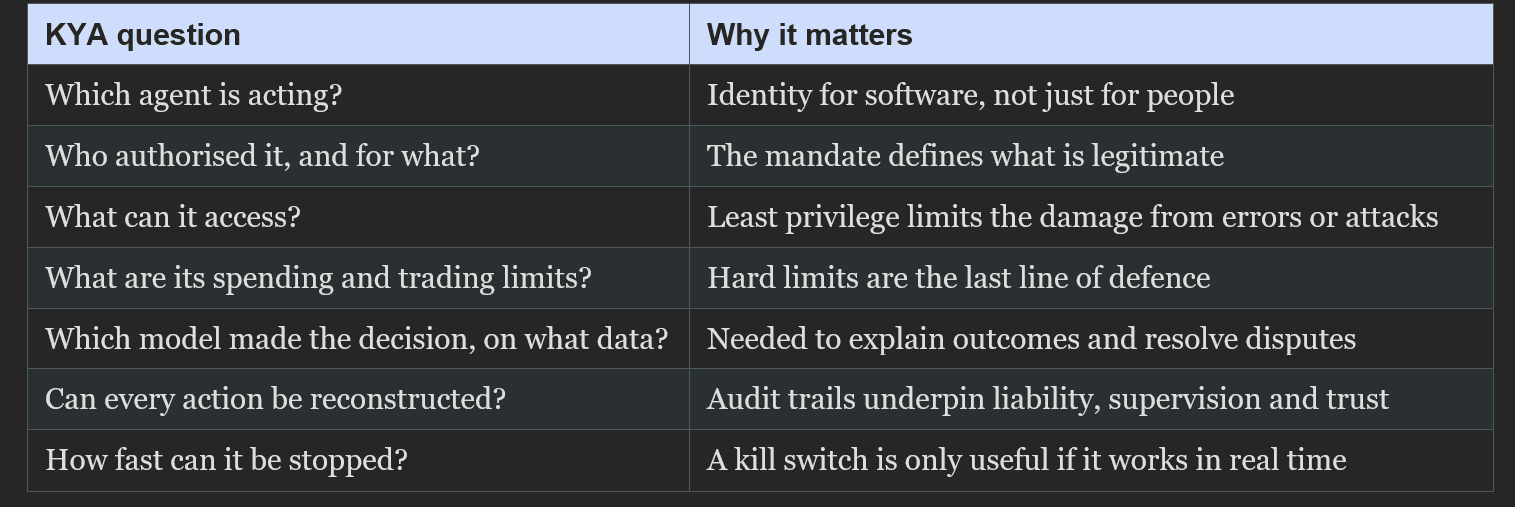
Today, it is beginning with brokerage accounts. Similar architectures could eventually reach treasury, payments, lending, wealth management and corporate finance. Financial institutions may need to serve not only human customers, but authorised software agents acting for those customers.
That means the control model must evolve. Beside Know Your Customer (KYC), institutions may need a discipline we could call Know Your Agent (KYA):
Before You Let an Agent Trade for You
For individual investors, a few practical questions are worth asking first:
1. What exactly can it do? Which instruments, which order types, and can it use margin?
2. What is the most I can lose? Fund the agent account only with money you can afford to lose.
3. Does it ask before acting? Start with approvals switched on and relax them only with experience.
4. How do I stop it, and how quickly does that take effect?
5. What does it read? The more open its information sources, the easier it may be to mislead.
6. Who is responsible if it gets it wrong? On current terms, usually you.
7. Does it account for costs and taxes? Frequent trading can quietly erase any edge.
The Question Is No Longer Whether AI Can Discuss Markets
We already know that it can. The more important question is what happens when AI can observe markets, use tools, make decisions and execute transactions.
The progression may look like this:
YESTERDAY: HUMAN → SOFTWARE → MARKET
TODAY: HUMAN → GOAL → AI AGENT → MARKET
TOMORROW: AGENT ↔ AGENT ↔ MARKET
That final stage may be the real beginning of agentic finance.
When millions of autonomous or semi-autonomous agents become market participants, we may not simply have faster trading. We may have a different market, one where the most important participants never sleep, never panic in the human sense, and may all think alike.
OVER TO YOU
Would you let an AI agent trade your money today? If yes, what limits would you insist on? If no, what would it take to change your mind? I would like to hear your views in the comments.
Selected References
Robinhood, "Robinhood is Now Open to Agents," May 27, 2026. https://robinhood.com/us/en/newsroom/robinhood-is-now-open-to-agents/
Robinhood, Q2 2026 Results, July 29, 2026. https://investors.robinhood.com/news-releases/news-release-details/robinhood-reports-second-quarter-2026-results
Robinhood, "Agentic Trading overview." https://robinhood.com/us/en/support/articles/agentic-trading-overview/
Robinhood, "Trading with your agent." https://robinhood.com/us/en/support/articles/trading-with-your-agent/
Vlad Tenev on X, agentic account milestones, June and July 2026. https://x.com/vladtenev/status/2067754874813710593
Interactive Brokers, AI Integration expansion, June 22, 2026. https://www.interactivebrokers.com/en/general/about/mediaRelations/6-22-26.php
Interactive Brokers, MCP connectivity, July 28, 2026. https://www.interactivebrokers.com/en/general/about/mediaRelations/7-28-26.php
Coinbase, "Coinbase for Agents adds equities and x402 payments," Sept. 22, 2026. https://www.coinbase.com/fr/developer-platform/discover/launches/c4a-equities-x402
BeInCrypto via Yahoo Finance, "Robinhood Plans to Let AI Agents Trade Crypto for US Customers," July 2026. https://finance.yahoo.com/markets/crypto/articles/robinhood-plans-let-ai-agents-105053282.html
FINRA, 2026 Annual Regulatory Oversight Report, GenAI section, December 2025. https://www.finra.org/rules-guidance/guidance/reports/2026-finra-annual-regulatory-oversight-report/gen-ai
Xia et al., "Agentic Trading: When LLM Agents Meet Financial Markets," 2026. https://arxiv.org/abs/2605.19337
Hua et al., "Agentic Quantitative Trading: A Survey of Workflows, Systems, and Evaluation," 2026. https://arxiv.org/abs/2608.31041
Aldridge et al., "Agentic Artificial Intelligence in Finance: A Comprehensive Survey," 2026. https://arxiv.org/abs/2604.21672