
Article · AI in Banking
The State of AI in U.S. Banking (2026)
The year 2026 marks a watershed moment in the adoption of artificial intelligence (AI) within the U.S. banking sector: the technology is no longer an experimental novelty but an operational reality for leading…
Dato Arif Siddiqui · 4 Jan 2026
The year 2026 marks a watershed moment in the adoption of artificial intelligence (AI) within the U.S. banking sector: the technology is no longer an experimental novelty but an operational reality for leading institutions. After nearly a decade of pilot projects, strategic statements, and vendor-led hype, the narrative has shifted. AI is now a measurable enterprise capability that must deliver value responsibly, reliably, and in compliance with rigorous regulatory expectations.
A New Phase: Execution Over Experimentation
Industry analysts and executives now frame 2026 as the first year of AI execution maturity. Leading voices in banking technology emphasize that this year will be defined by measurable outcomes, governance integration, and operational accountability, rather than exploratory pilots.
Across the industry, AI is now targeted at delivering efficiency gains, risk reduction, and strategic differentiation rather than purely boosting innovation optics. Adoption is real, yet uneven.
1. Adoption Landscape: Leaders, Laggards, and the Middle Ground
AI Maturity Rankings and Benchmark Data
Here is a recent AI maturity snapshot inspired by industry benchmarking (Evident AI Index, Teradata, and market analysis):
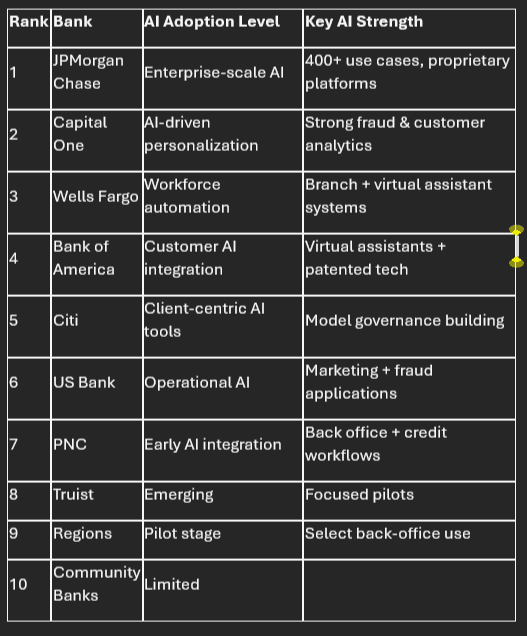
Source: AI Banking maturity data synthesis (2025–2026).
https://finance-connect.com/jpmorgan-chase-leads-global-banks-in-ai-adoption/?utm_source=chatgpt.com
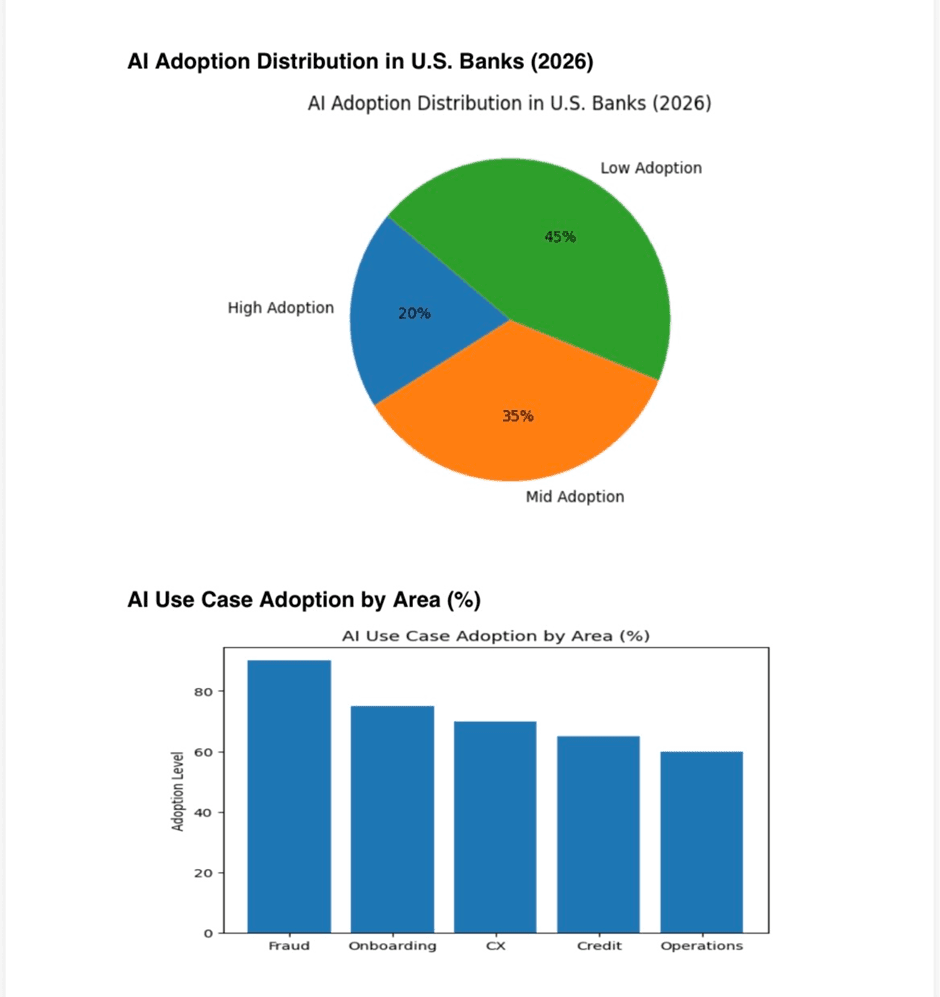
This chart conceptually illustrates a bell curve of adoption maturity:
• Leaders (top 20%) — enterprise-wide AI, governance, measurable outcomes
• Mid-tier (middle 35%) — significant pilots with selective rollouts
• Laggards (45%) — limited adoption, technology pilots only
Tier-1 Banks: AI at Enterprise Scale
The top U.S. banks — especially JPMorgan Chase, Capital One, Bank of America, Wells Fargo, and Citi — have moved far beyond experimentation:
• JPMorgan Chase operates an internal AI platform (OmniAI) across hundreds of use cases, from fraud detection to compliance and wealth planning.
• Bank of America has one of the largest portfolios of AI-related patents, embedding AI into products like its virtual assistant “Erica” to enhance customer engagement.
• Wells Fargo and Citigroup are embedding AI into broad workforce workflows, training tens of thousands of employees and accelerating productivity gains.
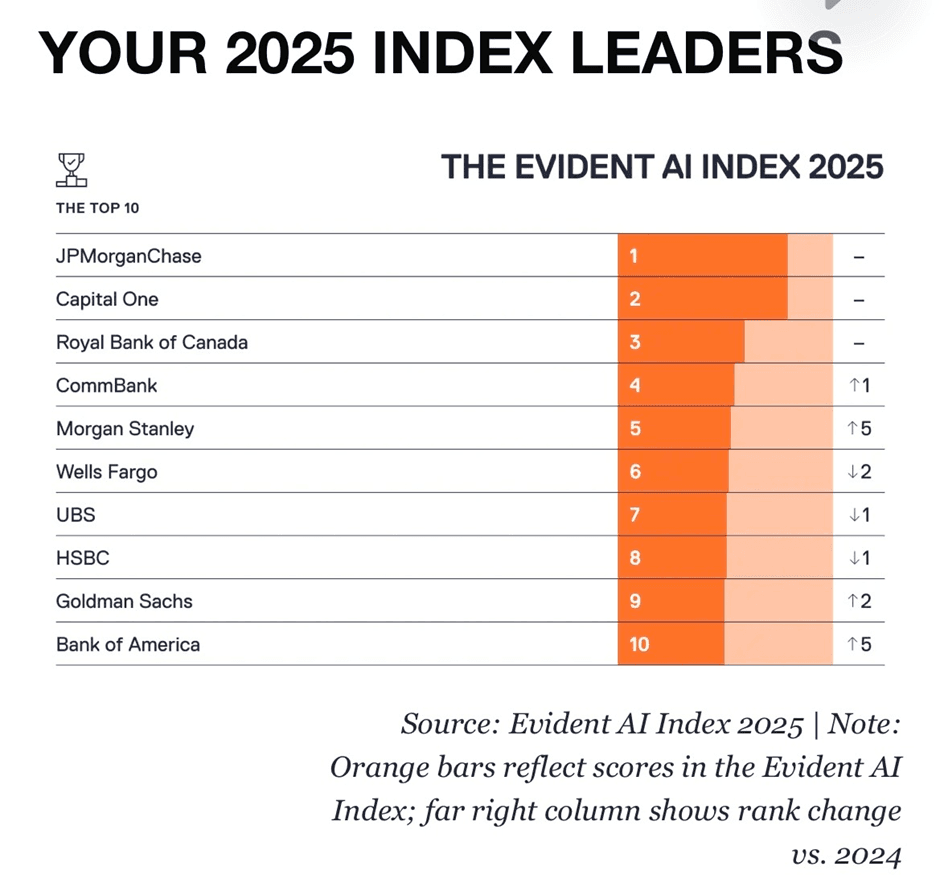
According to a major banking index, U.S. institutions dominate the top AI maturity ranks, supported by strategic investments, talent recruitment, and internal platforms.
2. Where AI Is Actually in Production (2026)
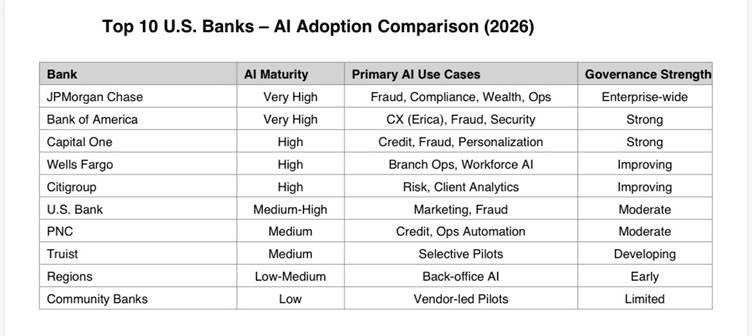
Rather than broad buzzword claims, the use cases in production today are specific, measurable, and operationally important:
Fraud Detection
AI models detect and prevent fraud in real time across digital channels, card network transactions, and cross-channel interactions. Standards now include pattern recognition, anomaly detection, and adaptive learning.
• Some fraud systems report false positive reductions up to 80% using advanced machine learning models.
These systems help protect billions of transactions yearly, enhancing risk detection while preserving customer experience.
Digital Onboarding & KYC
AI-assisted identity verification, behavior analysis, and liveness checks have reduced onboarding friction and fraud risk. These tools integrate with core bank systems to validate documents, profiles, and compliance flags.
Credit Decisioning & Underwriting
Machine learning models improve risk assessment by analyzing broader data beyond traditional scorecards. such as transaction patterns, cash flow dynamics, and behavioral indicators, for faster loan decisions.
Customer Engagement & Personalization
AI powers personalized recommendations, virtual assistants, and targeted service journeys. Integration with mobile apps and CRM ecosystems is now common among leaders.
Operational Productivity Tools
Generative AI and agentic AI systems are used for internal knowledge retrieval, documentation synthesis, and workflow optimization. These systems assist human analysts with tasks that would otherwise consume weeks of manual effort.
3. The Regulatory Landscape: Clarity and Expectations
Regulatory focus has shifted. In 2026, regulators are no longer asking if banks use AI — they are asking how, where, and under what controls. Guidance emerging from the Office of the Comptroller of the Currency (OCC), Federal Reserve, and Consumer Financial Protection Bureau (CFPB) emphasizes:
• Model risk management
• Fairness and consumer protection
• Transparency and explainability
• Data lineage and audit logging
AI is now viewed as a risk discipline, much like credit risk or operational risk, requiring formal governance and compliance processes.
Academic and policy research confirms this shift, showing regulators and academics alike urging banks to ground AI adoption in robust frameworks that ensure explainability and compliance through the lifecycle of models.
4. Operational Realities: Beyond the Hype
Despite clear progress, many banks still confront operational hurdles:
Data Quality and Infrastructure
AI success depends on clean, unified, and governed data — a challenge for banks with fragmented legacy systems. Poor data integrity can undermine model performance, create bias, and expose institutions to regulatory risk.
Model Drift & Monitoring
AI models degrade over time if not constantly monitored and retrained against changing market behaviors and patterns. Banks are still operationalizing model monitoring frameworks at scale.
Human Oversight and Integration
AI tools require human oversight for contextual judgment, escalation, and exception handling. Banks without clear governance are seeing AI outputs misinterpreted or misused.
Industry guidance underscores that sound AI practice requires embedding continuous monitoring, validation, and interpretability into every deployment.
5. Cultural & Organizational Shifts
From Labs to Line Ownership
AI’s biggest challenge has been integration into the business, not just technology labs. Leading banks are breaking silos — aligning data science, technology, business units, and risk functions.
Leadership Commitment
CEOs and boards are now driving AI agendas, tying them to strategic KPIs like productivity, risk reduction, and customer satisfaction. For example, reports indicate AI initiatives delivering measurable productivity increases of up to 6% in productivity for banks such as JPMorgan Chase.
6. AI Impact on Workforce & Jobs
AI is reshaping roles more than replacing them.
C-suite executives openly state that AI boosts productivity and redefines job expectations from branch operations to investment research. Employees are using AI tools daily to accelerate workflows, produce insights, and automate manual tasks.
7. Competitive Implications and Strategic Takeaways
Leaders Capture Value, Others Lag
Banks that embed AI into core processes with governance and risk control are creating durable competitive advantages. Those still piloting in isolated pockets risk being outcompeted by institutions with enterprise discipline.
Regulation, Governance, and Explainability Win
As oversight tightens, explainable, auditable AI systems increasingly outperform black-box solutions. Sustainable AI strategies are defined by governance + operational integration.
Artificial intelligence in U.S. banking in 2026 is no longer an experiment; it is an enterprise capability.
The winners are not merely the banks with the most advanced models or the largest technology budgets. Instead, success belongs to those who combine:
• Disciplined execution
• Robust governance and risk management
• Clean data infrastructure
• Human oversight and explainability
• Leadership commitment from the C-suite to the frontline
AI in banking has matured, but it remains unstable. The next phase will reward institutions that strike a balance between innovation and responsibility, delivering measurable value within a regulated and accountable framework.
References & Further Reading
Forbes – AI reshaping banking (2026): https://www.forbes.com/councils/forbesfinancecouncil/2025/12/16/2026-predictions-the-year-ai-reshapes-banking-and-the-financial-system/
Reuters – Bank of America AI: Evident AI Index – https://www.reuters.com/technology/bofa-clinches-record-number-patents-with-ai-information-security-focus-2024-03-06/
Texas Bankers Association – Banking education: https://www.texasbankers.com/events-education
https://arxiv.org/abs/2503.14541?utm_source=chatgpt.com
https://www.articsledge.com/post/ai-banking?utm_source=chatgpt.com