
Article · AI in Banking
The Future of Money in a Digital World: Stablecoins vs. CBDCs
Stablecoins are a crucial innovation in the crypto world, providing the advantages of digital assets while reducing the volatility of traditional cryptocurrencies like Bitcoin and Ethereum.
Dato Arif Siddiqui · 2 Apr 2025
Stablecoins are a crucial innovation in the crypto world, providing the advantages of digital assets while reducing the volatility of traditional cryptocurrencies like Bitcoin and Ethereum. By early 2025, the stablecoin market will have grown, reaching a global market capitalization exceeding $220 billion. The U.S. dollar’s dominance in the digital economy is highlighted by the fact that it underpins most stablecoins—about 99%. This article discusses stablecoins’ operations, various business uses, and influence in the U.S. because of regulatory support.
Understanding Stablecoins
Stablecoins are digital currencies that aim to keep a stable value by pegging to reserve assets like fiat currencies or commodities. They use algorithmic mechanisms for stability, making them good for transactions, savings, and remittances. This helps to overcome the price volatility that affects the wider use of other cryptocurrencies. The main stablecoins are: World Economic Forum
Reserves of fiat currency support stablecoins in banks. Each stablecoin corresponds to a unit of the currency in reserve. For instance, USD Coin (USDC) is pegged to the U.S. dollar and operates on various blockchain networks. Crypto-Collateralized Stablecoins use cryptocurrencies as collateral, usually over-collateralized to adjust for volatility. Smart contracts manage the issuance and redemption processes to maintain the peg.
Algorithmic Stablecoins use algorithms and smart contracts to adjust the stablecoin supply. This helps in keeping a stable value with no need direct collateral backing.
Global Adoption and Success of Stablecoins
Stablecoins are essential to global financial systems and see widespread use in many countries. In Latin America, they are popular for remittances and to protect against unstable local currencies. The region received around $415 billion in cryptocurrency between July 2023 and June 2024, with stablecoins playing a key role. In areas with high inflation or limited financial options, stablecoins help people and businesses maintain their buying power and make transactions easier.
Business Use Cases of Stablecoins
Stablecoins are versatile and used in many business contexts. They improve operational efficiency and financial inclusivity.
- Traditional international payments are often slow and costly. Stablecoins enable near-instantaneous transfers with minimal fees, enhancing efficiency in global trade. For example, businesses can send payments to international suppliers in minutes rather than days, reducing transaction costs significantly.
- Payroll Solutions: Companies employing international staff or contractors face challenges with varying currencies and transfer fees. Paying salaries in stablecoins simplifies the process, ensuring timely and cost-effective payments. This approach is beneficial for freelancers and remote workers across different countries.
- E-Commerce Payments: E-commerce platforms can accept stablecoins, providing customers with more payment options and reducing reliance on traditional banking systems. This approach can lower transaction fees and expand market reach.
- Supply Chain Financing: Stablecoins facilitate transparent and efficient transactions between suppliers, manufacturers, and retailers. By using stablecoins, parties can ensure prompt payments and reduce the risk of fraud.
- Decentralized Finance (DeFi) Participation: Businesses can engage in DeFi platforms using stablecoins for lending, borrowing, and earning interest, leveraging blockchain technology for financial growth.
Impact in the USA Since Regulatory Approval
The United States has witnessed significant developments blecoin sector following regulatory approvals:
Regulatory Framework: The introduction of legislation such as the STABLE Act aims to establish a comprehensive regulatory framework for stablecoins, providing legitimacy and encouraging adoption. The act mandates stablecoin issuers meet rigorous standards, similar to those of federally regulated financial institutions. Axios
Financial Institutions’ Involvement: Major banks and FinTech companies are entering the stablecoin market. For example, Fidelity Investments plans to launch its stablecoin as part of its digital assets drive, aligning with the U.S.’s upcoming regulatory framework for cryptocurrencies. Financial Times
Political Considerations: The involvement of prominent figures, such as the Trump family’s backing of World Liberty Financial’s USD1 stablecoin, has introduced political dynamics into the stablecoin discourse. While aiming to reinforce the U.S. dollar’s dominance, these ventures have raised concerns about potential conflicts of interest and regulatory challenges. Politico
Market Dynamics: The stablecoin market has experienced rapid growth, with increased integration into traditional financial systems. This expansion prompts discussions on financial stability and the need for robust regulatory oversight to mitigate risks associated with market volatility and reserve transparency.
Technological Integration: Companies like Mastercard are developing infrastructure to facilitate stablecoin transactions, aiming to replicate the efficiency of traditional payment networks in the digital asset space. These initiatives signal a broader acceptance and integration of stablecoins into mainstream financial services.
Stablecoins are a significant financial innovation that combines the stability of traditional assets with the benefits of digital currencies. They have various business uses, such as simplifying cross-border transactions and improving e-commerce.
In the United States, regulatory changes and greater participation from financial institutions and political figures emphasize the increasing significance of stablecoins. As the market progresses, focusing on regulatory frameworks, transparency, and risk management will be essential.
Stablecoins are becoming powerful rivals to Visa and Mastercard in the US. In 2024, stablecoin transfers hit $27.6 trillion, exceeding Visa and Mastercard’s combined volumes by 7.68%, as reported by Criptoslate.com. I think this claim may be exaggerated. Coinspeaker+2CryptoSlate+2CryptoNinjas+2
Advantages of Stablecoins Over Traditional Payment Networks
Stablecoins offer several benefits that challenge the dominance of established payment systems:
Lower Transaction Fees: Stablecoin transactions often incur minimal fees compared to the charges imposed by traditional credit card networks. This cost-effectiveness appeals to both merchants and consumers seeking to reduce expenses.
Faster Settlement Times: While Visa and Mastercard transactions may take days to settle, stablecoin transactions can complete within minutes, enhancing cash flow and reducing counterparty risk.
Accessibility: Stablecoins facilitate financial inclusion by providing services to unbanked or under-banked populations, enabling participation in the digital economy without traditional banking infrastructure.
Programmability: Built on blockchain technology, stablecoins support programmable transactions via smart contracts, allowing for automated and conditional payments, which are not workable with traditional payment networks.
Challenges and Considerations
Advantages, stablecoins face challenges in competing with Visa and Mastercard:
Regulatory Uncertainty: The U.S. lacks comprehensive stablecoin regulations, hindering widespread adoption and integration into the mainstream financial system. Clear regulatory frameworks are essential for addressing concerns related to consumer protection and financial stability.
Scalability and Network Effects: Visa and Mastercard benefit from extensive networks and established trust. For stablecoins to compete effectively, they must achieve similar scalability and user adoption.
Security Concerns: While blockchain technology offers enhanced security features, the broader cryptocurrency ecosystem has experienced incidents of fraud and hacking, which may deter users accustomed to the protections offered by traditional payment networks.
Stablecoins present a viable alternative to traditional payment networks by offering lower fees, faster settlements, and increased accessibility. Their growing adoption shows a shift in the payment landscape. However, addressing regulatory challenges and building trust are critical for stablecoins to compete effectively with entrenched players like Visa and Mastercard in the U.S. market.
Use Cases of Stablecoin:
Several financial institutions and fintech companies have launched stablecoin initiatives in the past year. The goal is to improve payment systems, lower transaction costs, and enhance cross-border transactions. Some notable developments include:
PayPal’s PYUSD Integration: In November 2024, PayPal expanded the use of its stablecoin, PayPal USD (PYUSD), by enabling disbursement partners to settle cross-border money transfers via Xoom using PYUSD. This initiative leverages blockchain technology to provide faster and more cost-effective international remittance services. Partners like Cebuana Lhuillier and Yellow Card were among the first to adopt this settlement method. EMARKETER+2FXC Intelligence+2PayPal Newsroom+2PayPal Newsroom
FV Bank’s Adoption of PYUSD: In January 2025, FV Bank added PYUSD to its services. Customers can now get direct deposits and make outbound payments, like remittances, with instant conversion to U.S. dollars. This move helps FV Bank lead in providing stablecoin deposits with regular banking services. Axios+3EMARKETER+3Press Release & Investor Services+3Press Release & Investor Services
Fidelity Investments’ Stablecoin Initiative: Fidelity Investments will launch its stablecoin as part of its digital assets strategy. The move follows the expected U.S. regulations for cryptocurrencies and shows Fidelity’s dedication to digital asset innovation. Financial Times
Mastercard’s Multi-Token Network: Mastercard is creating the Multi-Token Network to mirror its card network in the blockchain industry. The platform aims to allow simple transactions of digital assets among consumers, merchants, and financial institutions. It will make it simpler to move between fiat and cryptocurrencies. Business Insider
Standard Chartered’s HKD-Backed Stablecoin: Standard Chartered’s Hong Kong division is partnering with Animoca Brands and HKT to create a joint venture. They aim to get a license for issuing a stablecoin backed by the Hong Kong dollar. The goal is to use blockchain technology to improve local and international payment systems. Reuters+1World Economic Forum+1
Visa’s Tokenized Asset Platform: Visa introduced VTAP to connect fiat currencies with blockchain networks. VTAP helps banks handle fiat-backed tokens and stablecoins for issuing and managing digital assets. BBVA intends to use VTAP to release its stablecoin by 2025. The Verge+1Nasdaq+1
The initiatives show a big change in using stablecoins in regular financial services to make transactions faster, cheaper, and more accessible.
Stablecoin vs CBDC
Stablecoins and Central Bank Digital Currencies (CBDCs) are digital assets for transactions. They differ in issuance, control, and mechanisms.
Stablecoins are digital currencies typically issued by private entities, pegged to stable assets like fiat currencies or commodities to minimize volatility. For example, USD Coin (USDC) is a stablecoin pegged to the U.S. dollar, aiming to maintain a 1:1 value ratio.
CBDCs, conversely, are digital currencies issued and regulated by central banks, representing a digital form of a country’s sovereign currency. Central banks centralize them and they serve as legal tender, backed by the full faith of the issuing government.
Atlantic Council+8World Economic Forum+8Deltec Bank and Trust+8
Comparative Analysis: Stablecoins vs. CBDCs
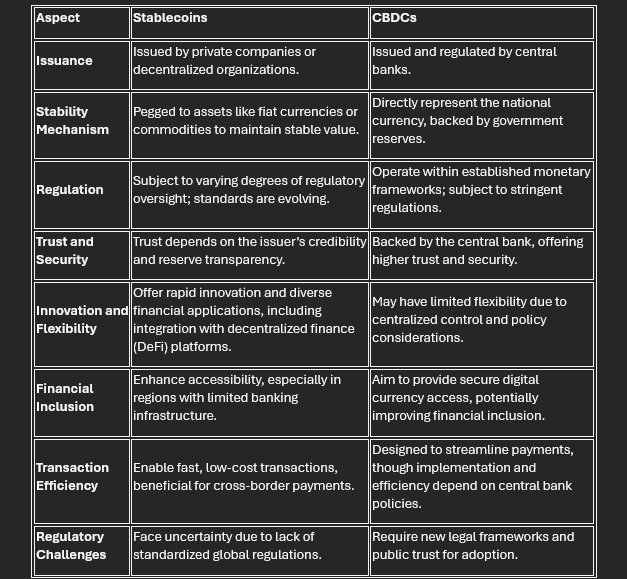
Pros and Cons
Stablecoins
Innovation: Rapid development and integration with various financial services. Flexibility: Adaptable to different platforms and use cases, including DeFi. Financial Inclusion: Provide access to digital assets for unbanked populations.
Regulatory Uncertainty: Lack of consistent oversight can lead to risks. Trust Issues: Dependence on issuer’s credibility and reserve management. Potential for Misuse: Risk of being used for illicit activities due to decentralized nature.
CBDCs
Stability: Backed by central banks, ensuring trust and security.World Economic Forum Monetary Control: Enable precise implementation of monetary policies.Atlantic Council+1Federal Reserve Bank of New York+1 Consumer Protection: Offer legal safeguards inherent in sovereign currencies.
Implementation Complexity: Requires significant infrastructure and policy development. Privacy Concerns: Centralized data collection may raise surveillance issues. Potential to Disrupt Banking Sector: Direct access to central bank money could impact traditional banks’ roles.
Stablecoins and CBDCs represent two distinct approaches to digital currency, each with unique advantages and challenges. Stablecoins offer innovation and flexibility driven by the private sector, while CBDCs provide stability and trust underpinned by central banks. The future financial landscape may see these digital currencies coexisting, each serving different needs and user preferences.