
Article · AI in Banking
Regulators vs Innovation: A False Conflict
A persistent misconception in banking is that regulators delay or suppress AI innovation. Many bank leaders privately assume that the faster they move, the more likely regulators will intervene.
Dato Arif Siddiqui · 16 Jan 2026
A persistent misconception in banking is that regulators delay or suppress AI innovation. Many bank leaders privately assume that the faster they move, the more likely regulators will intervene. In reality, the opposite is increasingly true: regulators encourage controlled innovation that aligns with risk management, transparency, and consumer protection principles. By 2026, this balanced view has become mainstream among forward-looking banks, policy makers, and industry consortia.
In the U.S., financial regulators do not operate in a technological vacuum. They enforce existing safety, soundness, and consumer protection laws regardless of technology. As financial regulators themselves note, AI systems are not exempt from laws governing model risk, data privacy, discrimination, and transparency simply because they are “innovative.” At the same time, agencies at the federal and state levels increasingly recognize AI’s potential to improve fraud detection, risk assessment, customer experience, and operational efficiency, provided that use cases are governed with disciplined controls. These dual expectations, innovation and risk management, are not irreconcilable; they are mutually reinforcing.
U.S. Regulatory Landscape: Guardrails, Not Roadblocks
Regulators such as the Office of the Comptroller of the Currency (OCC), Federal Reserve, Federal Deposit Insurance Corporation (FDIC), and Consumer Financial Protection Bureau (CFPB) use existing supervisory frameworks to oversee AI deployments. These frameworks focus on model risk management, fair lending and consumer protection, and operational resilience rather than singling out AI as an end in itself. The foundational expectation is clear: if an institution uses AI, it must manage it at least as rigorously as any other risk-bearing process.
For example, the OCC, historically one of the most influential banking regulators, emphasizes that AI systems should be treated as high-stakes quantitative models subject to validation, performance monitoring, and independent review. This is consistent with the OCC’s long-standing supervisory expectations under SR 11-7, which require proper governance for all model types.
The CFPB monitors advanced technologies for potential impacts on fairness, discrimination, and data privacy. Its “Advanced Technology” guidance highlights the need for consumer protections in emerging tech deployments, including AI. Regulators do not prohibit technology; they insist on legal compliance and consumer safeguarding.
In 2024 and 2025, U.S. regulators explicitly reaffirmed that existing statutes governing unfair, deceptive, and abusive practices (UDAAP), fair lending, and privacy apply to AI just as they do to traditional decision systems. This means banks must validate AI models not only for predictive accuracy, but also for explainability, bias mitigation, and documented risk controls.
Regulation as an Enabler of Innovation, Not Its Opposite
The regulatory intention behind AI oversight is often misunderstood. U.S. regulators, including the Treasury Department, explicitly seek to ensure innovation is accompanied by robust risk management, rather than stifling it. In the Treasury’s “Artificial Intelligence in Financial Services” report, regulators and policymakers acknowledged the potential of AI to advance fraud detection, customer protection, operational efficiency, and financial inclusion, while urging firms to invest in risk governance rather than evade oversight.
The GAO (Government Accountability Office) echoed this balanced approach in a 2025 report, noting that regulators play a critical role not only in risk mitigation but also in shaping shared understanding of how AI technologies should be implemented responsibly across banks. Rather than instructing firms to abandon innovation, the GAO highlighted how regulators and institutions can co-develop risk mitigants that protect consumers without suppressing technological progress.
Academic research confirms that strong corporate governance frameworks significantly increase the likelihood that AI initiatives succeed and do so in compliance with regulatory expectations. One study found that banks with integrated risk and governance practices were more effective in deploying AI systems that complied with legal, ethical, and operational risk boundaries, resulting in measurable performance improvements and reduced regulatory friction.
International perspectives also reinforce this view. Regulatory insight papers from the Bank for International Settlements emphasize that regulation and innovation must advance together to unlock the full benefits of AI while maintaining systemic stability and consumer welfare.
Why Misconceptions Persist
Many bank executives view regulators as adversaries because regulatory feedback often arrives late, after products developed or pilots have been deployed. When firms fail to engage regulators early in the AI lifecycle, regulatory responses can seem punitive. In reality, regulators are reacting to missing documentation, insufficient risk controls, and opaque decision logic, not to innovation itself.
This misunderstanding often comes from banks viewing innovation as a competition with regulators rather than engaging in a dialogue with stakeholders. Regulators consistently emphasize that lacking strong governance, risk documentation, and transparency raises regulatory risk, not innovation itself. Simply deploying AI faster without proper governance does not cut regulatory barriers; it heightens them.
A clear example is fraud detection AI. Banks that deployed models without clear audit trails and explainability faced increased scrutiny from examiners, not because the models worked poorly, but because regulators needed to verify that risk controls, data governance, and escalation pathways were in place. Conversely, institutions that embedded explainability, performance monitoring, and documented governance into their workflows experienced smoother regulatory reviews and fewer corrective actions. Emerging “AI governance frameworks” such as those supported by the National Institute of Standards and Technology (NIST) AI Risk Management Framework help banks satisfy these expectations.
Use Cases Where Regulation and Innovation Work Together
Fraud Detection and AML: AI systems can flag complex patterns across millions of transactions. Regulators are not opposed to this; they require auditability and bias controls. Tools must provide evidence of performance, anti-bias testing, and explainable logic. Institutions embracing these practices have reported both stronger regulatory engagement and reduced false positives without slowing deployment.
Credit Decisioning: AI models can incorporate non-traditional data to assess creditworthiness. While regulators are vigilant about discriminatory outcomes, blended models that include governance layers (bias testing, audit logs, model explainability) have enabled innovation within regulatory comfort. This has improved loan inclusivity without inviting regulatory pushback.
Customer Service Automation: Banks using natural language processing (NLP) tools reported faster response times and reduced call center loads. Regulators did not discourage these technologies; they insisted on privacy safeguards, disclosure practices, and monitoring of adverse customer outcomes. Banks aligned with these expectations avoided enforcement actions and improved customer satisfaction.
These examples show that innovation and regulation can be complementary. Regulation does not demand innovation slow down; it demands innovation that is responsible, explainable, and resilient.
Guiding Principles for Banks: Collaboration With Regulators
Successful banks in 2026 adopt a stakeholder mindset toward regulators rather than a defensive one. This means engaging regulators earlier in the lifecycle, sharing documentation proactively, and co-designing risk controls.
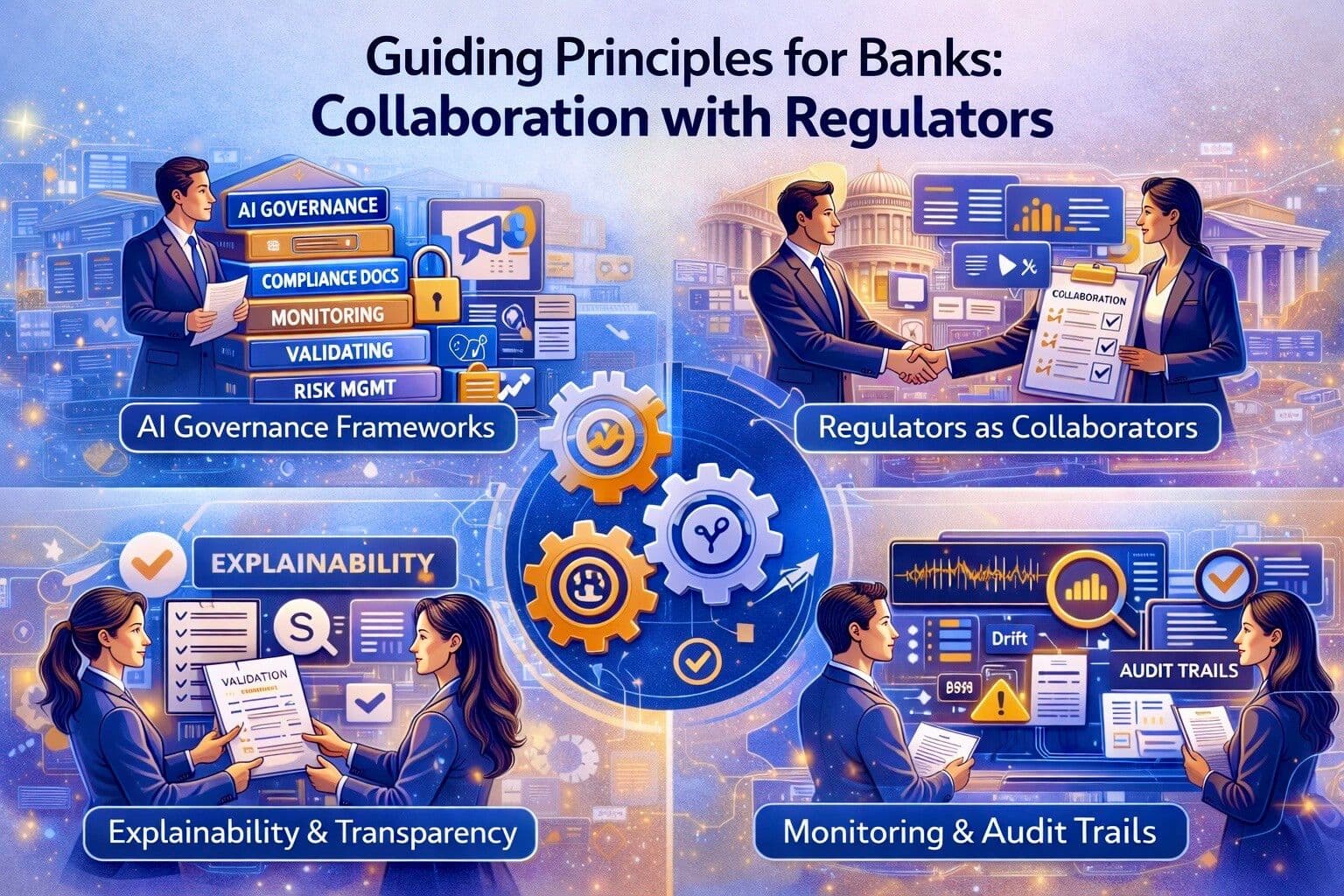
Principle 1: Build AI governance frameworks that integrate risk management, model validation, performance monitoring, and compliance documentation. Resources such as the AI governance frameworks from industry groups provide starting points to align risk controls with regulatory expectations.
Principle 2: Treat regulators as collaborators in risk understanding, not obstacles to speed. Open dialogue helps shape supervisory expectations and reduces surprises during exams.
Principle 3: Focus on explainability and transparency aligned with regulatory standards rather than on maximizing model complexity devoid of controls. Institutions with strong documentation and validation artifacts experienced fewer remediation directives.
Principle 4: Embed continuous monitoring and audit trails into production AI workflows so changes, drift, and emergent behaviors are visible — not opaque.
By adopting these principles, banks enable quicker innovation cycles within regulatory comfort zones, instead of repeatedly revising deployments after setbacks from enforcement or examinations.
Regulation and Innovation as Co-Drivers
In 2026, the narrative that “regulators inhibit innovation” is outdated. What regulators actually inhibit is innovation without governance — innovation that creates risk without transparency or accountability. U.S. financial regulators do not demand stagnation; they demand responsible progress. By aligning AI strategies with regulatory frameworks that emphasize risk management, explainability, fairness, and consumer protection, banks can innovate with confidence and broader societal trust.
Innovation and regulation are not opposites. They are interdependent forces that drive sustainable value, resilience, and trust in AI-enabled banking. Institutions that treat regulators as stakeholders, rather than adversaries, are the ones that innovate successfully and safely.
References & Further Reading
Enabling 21st Century AI Innovation in Financial Services, Published by American Bankers Association; https://www.aba.com/advocacy/policy-analysis/sfr-on-ai-innovation
This report explains how U.S. banking regulation supports responsible AI innovation rather than blocking it.
Artificial Intelligence in Financial Services; Published by the U.S. Department of the Treasury; https://home.treasury.gov/system/files/136/Artificial-Intelligence-in-Financial-Services.pdf
A comprehensive U.S. government report covering AI opportunities, risks, governance, and regulatory expectations.
GAO Report on AI Use and Oversight in Financial Services; Published by the U.S. Government Accountability Office; https://www.gao.gov/products/gao-25-106201
Explains how regulators and financial institutions oversee AI systems and manage associated risks.
AI Governance Frameworks for AML and Compliance Teams; Published by Unit21; https://www.unit21.ai/blog/ai-governance-frameworks-a-deep-dive-into-aml-risk-controls
A practical, industry-focused explanation of governance controls required for AI in AML and financial crime.
AI Risk Management in Financial Services – Regulatory Perspectives; Published by INNREG; https://www.innreg.com/blog/ai-risk-management-in-financial-services
Covers regulatory approaches to AI risk, compliance expectations, and supervisory trends.
NIST AI Risk Management Framework (AI RMF); Published by National Institute of Standards and Technology; https://www.nist.gov/itl/ai-risk-management-framework