
Article · AI in Banking
Ranking 10 U.S. Banks for Customer Onboarding
Part 1 article established an important finding: digital account opening is mature across major U.S. banks, while the technology and workflow inside branches are much less transparent.
Dato Arif Siddiqui · 10 Sept 2026
Part 2 of a four-article U.S. retail onboarding benchmark
Part 1 article established an important finding: digital account opening is mature across major U.S. banks, while the technology and workflow inside branches are much less transparent. Part 2 converts that evidence into a structured benchmark. The objective is not to declare a universal 'best bank.' It is to compare the strength of publicly evidenced onboarding capabilities using a consistent seven-dimension model.
How the benchmark was scored
The scoring model gives the greatest weight to the customer outcome: experience and speed together represent 45% of the total. Branch technology and digital onboarding contribute another 30%, while KYC automation, channel integration and AI enablement complete the model.
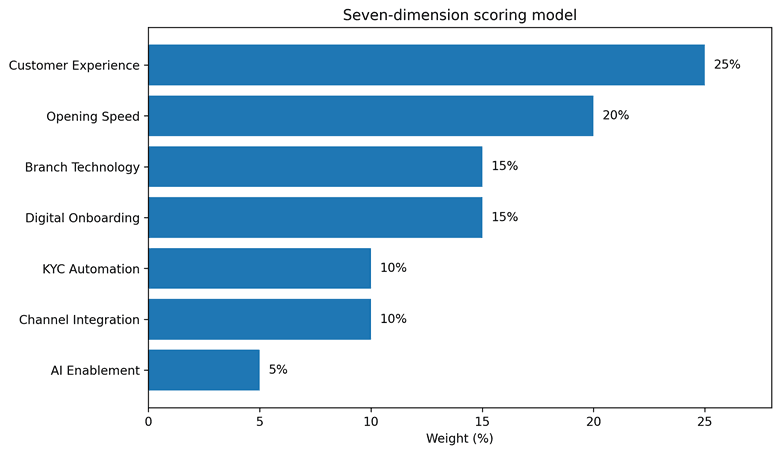
Figure 1. The seven-dimension weighting model.
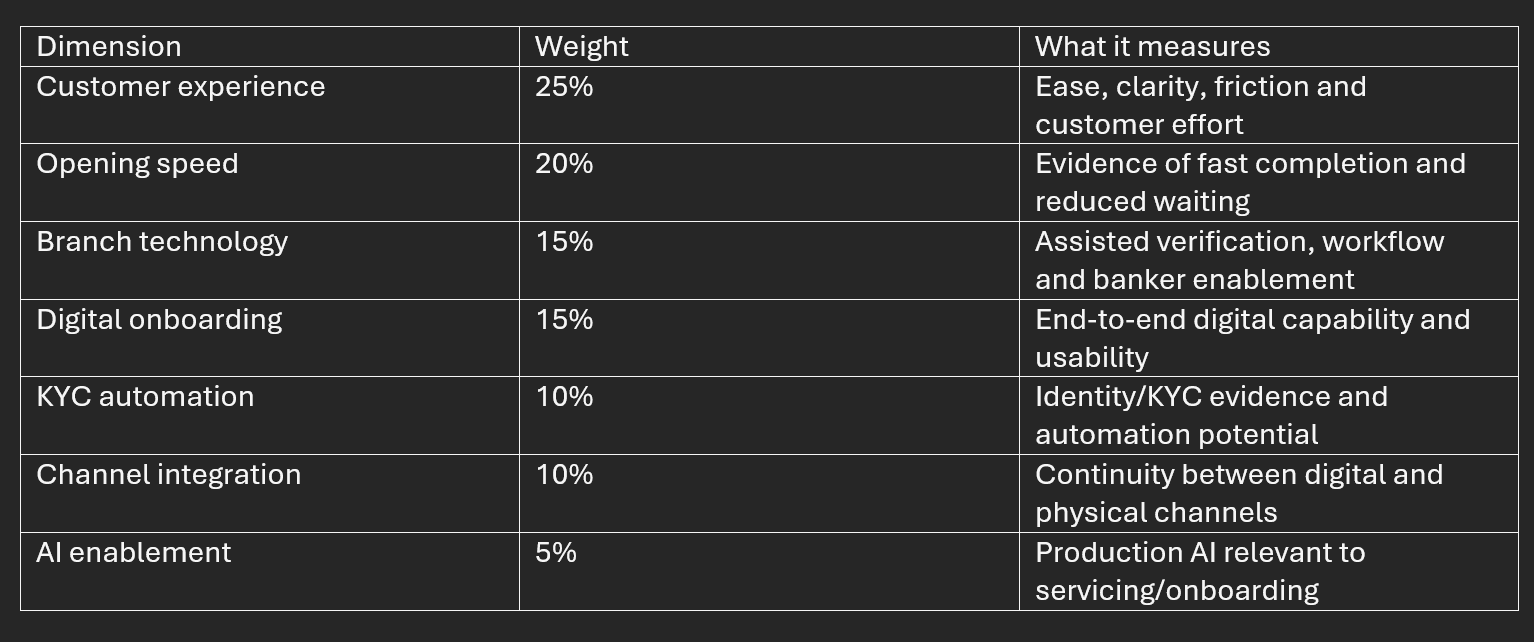
Performance score is not evidence confidence
A central design decision was to separate capability performance from evidence confidence. A bank should not receive a zero merely because a branch workflow is not publicly documented. Conversely, a known vendor relationship should not be treated as proof that a specific module is implemented, integrated and used.
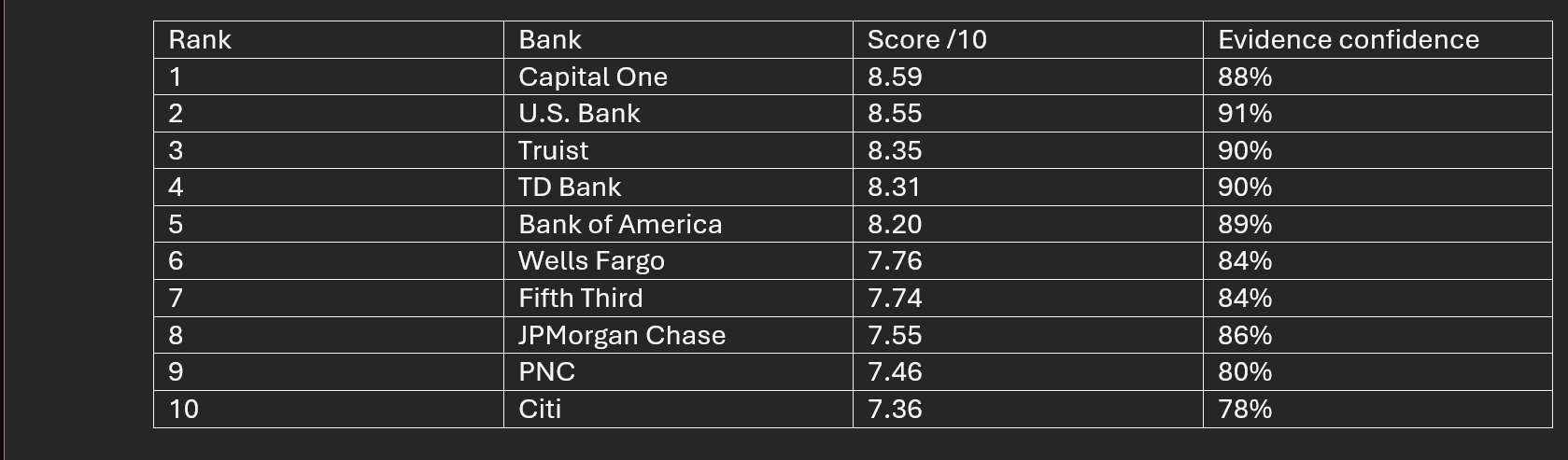
Evidence confidence therefore follows the Stage 1A hierarchy: A1 bank-direct evidence, A2 bank-and-vendor evidence, B named vendor case study, C credible external evidence, D inference only and NV where no credible public evidence was found.
The ranking
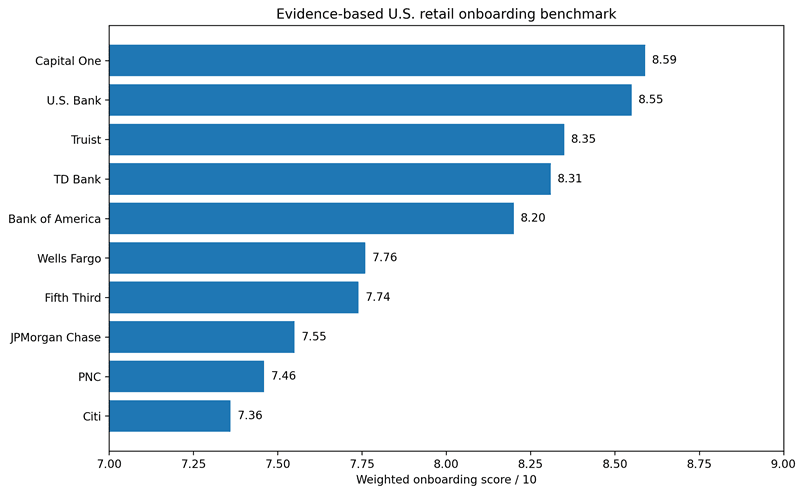
Figure 2. Overall weighted onboarding scores.
Tier 1: Capital One and U.S. Bank
Capital One ranks first at 8.59, only four-hundredths of a point ahead of U.S. Bank at 8.55. The difference is too small to treat as a decisive competitive gap. The more useful conclusion is that they lead for different reasons.
Capital One is the most balanced cross-channel performer in the model. Its public guidance shows a useful digital-to-physical identity pattern: existing customers can generate a personalized QR code in the mobile app for in-person verification, while applicants requiring additional verification can be directed to a branch or Café.
U.S. Bank is the strongest hard speed benchmark. Its Bank Smartly Checking page states that customers can apply online in under five minutes. It also scores highest on digital onboarding in our model. This combination makes U.S. Bank particularly important when defining a future five-minute clean-case target.
Tier 2: Truist, TD Bank and Bank of America
Truist ranks third at 8.35. Its differentiator is activation and channel integration. Truist embedded electronic direct-deposit switching into digital account opening with Atomic and reported that 19% of new digital applicants who engaged with the feature completed the switch. That moves onboarding beyond account creation toward primary-account activation.
TD Bank ranks fourth at 8.31 and leads the benchmark on branch technology. Its public security guidance describes multiple in-person identity-verification methods, including debit card and PIN, smartphone and PIN, physical identification and single-use security codes. This is unusually visible evidence of branch authentication capability.
Bank of America ranks fifth at 8.20. Its standout dimension is AI enablement. In March 2026, the bank reported 20.6 million Erica users and nearly 700 million interactions during 2025, with more than 3.2 billion interactions since launch. That does not prove AI-powered account opening, but it demonstrates production-scale AI engagement that can support future onboarding and relationship journeys.
Tier 3: Wells Fargo, Fifth Third and JPMorgan Chase
Wells Fargo and Fifth Third are almost tied at 7.76 and 7.74. Both have strong evidence in core onboarding areas, but public proof of highly automated branch account-opening workflow remains limited.
Fifth Third receives a relatively strong AI score because Jeanie is already operating at scale. In August 2026 the bank said Jeanie could help customers complete more than 150 banking needs, with intent-recognition accuracy rising from about 20% to about 90% and self-service containment from 3% to 42%. Fifth Third separately describes account opening as part of its future agentic roadmap, so the benchmark does not treat current account opening as agentic.
JPMorgan Chase ranks eighth at 7.55. Its digital capability remains strong, but the opening-speed score is pulled down by a bank-direct branch datapoint: Chase tells students opening certain accounts in a branch to plan to spend an hour. This is not evidence that every Chase branch opening takes an hour; it is evidence that at least one disclosed assisted journey remains substantially heavier than leading digital benchmarks.
Tier 4: PNC and Citi
PNC scores 7.46 and Citi 7.36. These scores should be interpreted carefully. Both banks have substantial technology estates, but the benchmark found less public evidence at the exact retail onboarding and branch-workflow level. Their lower positions therefore reflect a combination of observed capability and evidence visibility.
The seven-dimension heat map
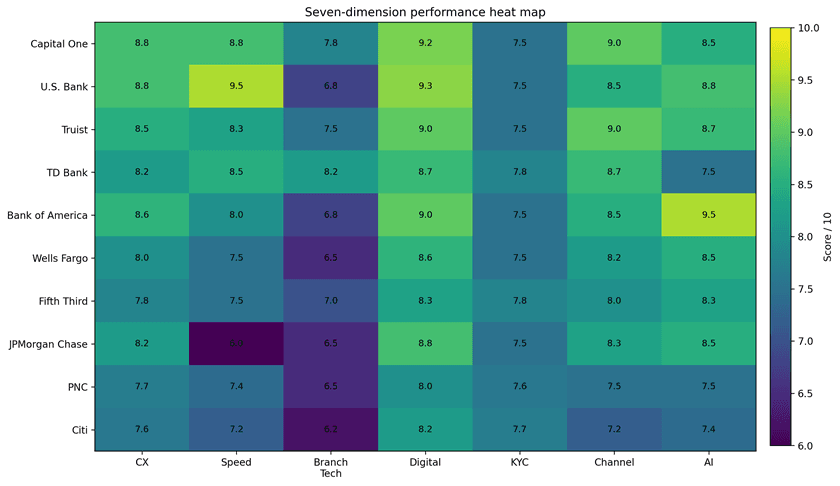
Figure 3. Dimension-by-dimension scores. The pattern matters more than small score differences.
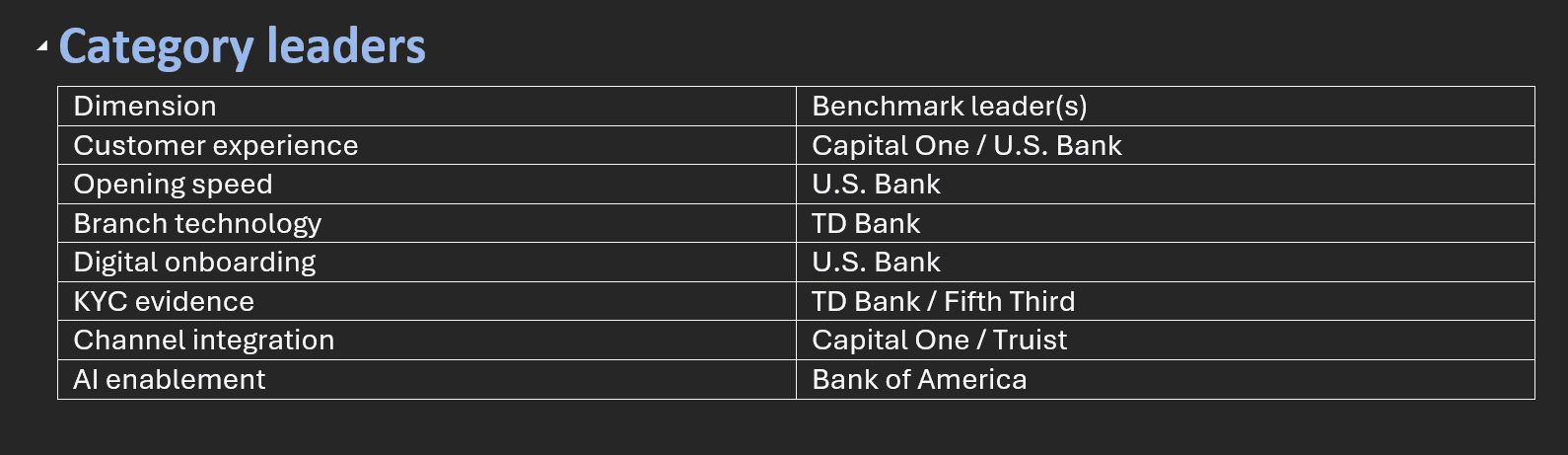
The heat map shows why a single overall score can hide important differences. U.S. Bank leads on opening speed and digital onboarding. TD leads on branch technology. Bank of America leads on AI enablement. Capital One and Truist lead on channel integration. No bank dominates every dimension.
Why confidence must remain visible
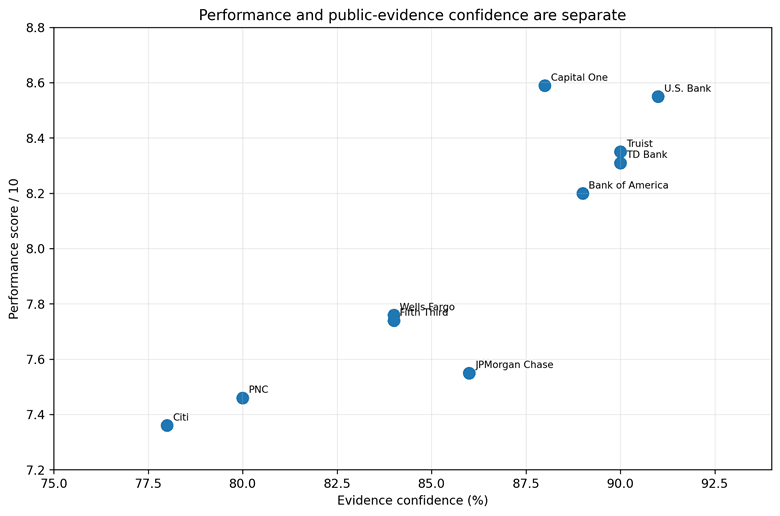
Figure 4. Performance score versus public-evidence confidence.
The performance-versus-confidence view is one of the most important controls in the research. Capital One, U.S. Bank, Truist, TD and Bank of America combine strong scores with relatively high evidence confidence. PNC and Citi sit lower on both measures, which means their positions should not be interpreted as proof of weak internal technology. They are partly a statement about what could be verified.
What the ranking tells us
Digital account opening is no longer the main differentiator; speed, continuity and activation increasingly are.
The best digital bank is not automatically the best branch-onboarding bank.
Branch identity and workflow remain under-disclosed across the industry.
AI leadership in servicing is emerging faster than publicly evidenced AI-led account opening.
Post-opening activation—funding, direct deposit, card activation and digital engagement—should be part of onboarding performance.
No single bank provides the complete target model.
The more useful conclusion: build a composite benchmark
The ranking is valuable, but the real objective is not to copy the bank in first place. The stronger strategy is to combine the best evidenced capabilities: U.S. Bank for digital speed, Capital One for cross-channel identity, TD for branch verification, Truist for activation and Bank of America for AI engagement.
Part 3 will turn that composite benchmark into a target operating model: a five-minute digital journey, a fifteen-minute branch journey, zero repeated data entry, persistent journey state across channels and a technology architecture that separates experience orchestration from legacy core systems.
Methodology note
This is an independent, evidence-based capability benchmark based on public information and structured scoring. It is not mystery shopping, a regulatory assessment, or a measurement of every account type and every customer experience. Scores are benchmark judgments, while evidence confidence records the strength of the public proof behind those judgments.
Selected current sources
· U.S. Bank — Bank Smartly Checking: online application in under five minutes.
· Capital One — In-person ID verification: personalized mobile QR code for existing customers and branch/Café verification paths.
· Truist — Direct-deposit switching embedded in digital account opening with Atomic; 19% of engaged applicants completed the switch.
· TD Bank — Security Center: multiple in-person identity-verification methods.
· Bank of America — March/July 2026 digital and Erica engagement disclosures.
· Fifth Third — June/August 2026 AI mobile interface and Jeanie disclosures.
· JPMorgan Chase — Student/college branch-opening guidance to plan to spend an hour.