
Article · AI in Banking
Optimizing AI Systems with Mixture of Experts (MOE): DeepSeek and Beyond
The Mixture of Experts (MoE) architecture is a transformative approach in AI. It enables models to scale while maintaining high performance across diverse tasks.
Dato Arif Siddiqui · 6 Feb 2025
Introduction to Mixture of Experts (MoE) in AI Systems
The Mixture of Experts (MoE) architecture is a transformative approach in AI. It enables models to scale while maintaining high performance across diverse tasks. MoE addresses the challenges of training larger neural networks by dividing a model into specialized sub-networks, or “experts.” Each expert is skilled at processing specific types of data or queries. A dynamic “gating mechanism” acts as a router, activating only the most relevant experts for input. This structure resembles a collaborative ensemble optimizing resource use and accuracy.
MoE is important because it separates model capacity from computational cost. Traditional models require more computation as they grow, but MoE systems scale more efficiently by activating only some experts. This allows the number of parameters to increase without an enormous increase in processing demands. For example, AI tool providers like ChatGPT use MoE to handle large datasets and complex tasks. Google’s Switch Transformer is an example of MoE’s potential, achieving speed and capability breakthroughs.
By balancing specialization and generalization, MoE enhances adaptability, allowing models to excel in varied contexts—from conversational AI to real-time decision-making. As AI systems grow, MoE stands as a cornerstone of scalable, efficient, and high-performing architectures, driving progress toward more sophisticated and accessible intelligent technologies.
Also, check for any jargon that might need explanation. Since the user asked for technical details, assume a knowledgeable audience. Use examples to clarify complex points.
DeepSeek’s Mixture of Experts (MoE) Implementation:
The Mixture of Experts (MoE) architecture is crucial for modern large-scale AI systems. It allows for scalability and specialization. DeepSeek, a leader in AI research and deployment, has developed an optimized framework based on this architecture. It ensures a balance between computational efficiency, model capacity, and task-specific performance. This Article explores DeepSeek’s MoE implementation. It focuses on architectural innovations, hardware integration, training methodologies, and real-world applications. DeepSeek’s MoE framework prioritizes sparse computation, dynamic resource allocation, and domain specialization. It represents the next generation of AI systems, which aim to achieve both breadth and depth of intelligence.
1. Architectural Design: Sparse Activation and Modular Expertise
DeepSeek’s MoE architecture uses sparse activation, activating only a fraction of the model’s parameters for each input. This differs from dense models, which use all parameters, leading to high computational costs. DeepSeek divides the model into expert modules and specialized sub-networks for specific data patterns or tasks. A dynamic gating mechanism routes inputs to the most relevant experts.
Expert Network Configuration
Each expert in DeepSeek’s framework is a self-contained feed-forward neural network (FFN) with a Transformer-based structure, though variations exist depending on the target application. For example, in natural language processing (NLP), experts might include:
- Syntax Experts: Specialized in grammatical structures, part-of-speech tagging, and sentence parsing.
- Semantic Experts: Focused on contextual meaning, entity relationships, and discourse coherence.
- Domain-Specific Experts: Tailored for niche areas like legal jargon (e.g., contract analysis), medical terminology (e.g., clinical note summarization), or programming languages (e.g., code generation).
A DeepSeek MoE model can accommodate 64 to 256 experts, each with 1 to 10 billion parameters. During inference, the model activates only 2 to 4 experts for each token, ensuring that the computational workload remains manageable even when the total number of parameters reaches the trillions.
Gating Mechanism and Hierarchical Routing
The lightweight gating network (a neural module) selects which experts to activate. DeepSeek’s router combines dense and attention-based layers to calculate a probability distribution over the experts. When given an input token, the router selects the top-k experts (k=2) based on Softmax scores. The system then weights and combines these selected experts to produce the final output.
To manage scalability, DeepSeek implements hierarchical routing:
- Cluster-Level Routing: Tokens are first assigned to a cluster of experts (e.g., 8 clusters of 32 experts each). This reduces the search space for the router.
- Intra-Cluster Routing: Within the selected cluster, a secondary router chooses the final 2 experts.
This two-tiered approach minimizes latency while maintaining precision, in models with hundreds of experts.
Load Balancing and Expert Utilization
A common challenge in MoE systems is expert collapse, where a minority of experts dominate the workload, leading to underutilization and redundancy. DeepSeek addresses this through:
- Auxiliary Loss Functions: A regularization term penalizes uneven distributions of tokens across experts. For instance, the load balancing loss encourages the gating network to distribute tokens, ensuring all experts contribute.
- Dynamic Capacity Buffers: A buffer capacity (e.g., 1.5x the average expected tokens per batch) is assigned to each expert. The system drops or reroutes tokens exceeding this threshold, preventing bottlenecks.
- Expert Warm-Up Phases: During early training stages, we constrain the gating network to assign tokens more evenly, allowing all experts to develop basic competencies before specialization begins.
2. Hardware Integration: Distributed Systems and Optimization
The developers integrated DeepSeek’s MoE framework with state-of-the-art hardware infrastructure, allowing for efficient distributed training and inference. The system takes advantage of parallelism at various levels to maximize throughput and minimize latency.
Expert Parallelism and GPU/TPU Clustering
In large-scale deployments, we distribute experts across GPU/TPU clusters. For example, a model with 128 experts might partition them across 32 GPUs, with 4 experts per GPU. During inference, the system routes tokens between devices using all-to-all communication.
DeepSeek’s hardware stack often employs Nvidia A100 or H100 GPUs, which offer dedicated tensor cores for mixed-precision computation and large memory bandwidth (up to 3.35 TB/s on H100). For ultra-large models, custom AI accelerators with optimized memory hierarchies are used to reduce data movement overhead.
Memory and Computation Optimization
- Gradient Checkpointing: To reduce memory usage during training, the system recomputes intermediate activations during backpropagation instead of storing them. These trades compute for memory, enabling the training of larger batches.
- Mixed-Precision Training: Experts operate in FP16 or BF16 precision, with master weights maintained in FP32 for stability. This reduces memory usage by 50% and accelerates matrix operations.
- Kernel Fusion: DeepSeek’s custom CUDA kernels merge operations like attention scoring and expert routing into single GPU instructions, minimizing kernel launch overhead.
Hybrid Parallelism Strategies
DeepSeek combines three parallelism paradigms:
Data Parallelism: We split batches across devices (e.g., 8 GPUs process 8 subsets of a batch).
Expert Parallelism: We distribute experts across devices, as described above.
Tensor Parallelism: We split individual experts across multiple devices (e.g., we divide an expert’s feed-forward layers between 2 GPUs).
This hybrid approach saturates computational resources, even for models with trillions of parameters.
3. Training method: Specialization and Efficiency
DeepSeek’s training pipeline for MoE models emphasizes gradual specialization, adaptive resource allocation, and robustness to distribution shifts.
Curriculum Learning for Expert Specialization
A phased curriculum trains experts.
- Phase 1 (General Pretraining): Diverse data (e.g., web text, books, code) exposes all experts to build foundational skills. The researchers disable the gating network, thus forcing uniform expert utilization.
- Phase 2 (Task-Specific Fine-Tuning): We activate the gating network, and the experts specialize. For example, in a multilingual model, experts might self-organize into language-specific clusters.
- Phase 3 (Dynamic Adaptation): We deployed the model in production with continuous learning enabled. The system updates the experts based on user interactions, while the gating network adapts to shifting query patterns.
Dynamic Batch Sizing and Sparse Gradients
To optimize hardware utilization, DeepSeek employs dynamic batch sizing:
Small Batches (32–64 samples): Used for complex tasks (e.g., mathematical reasoning) requiring heavy expert computation.
Large Batches (1024+ samples): Applied to simpler tasks (e.g., text classification) where expert workloads are lighter.
Sparse gradient updates change during backpropagation only the weights of activated experts. This reduces computation by up to 70% compared to dense models.
Regularization and Robustness
Noisy Routing: During training, the system injects random noise into the gating network’s logits, encouraging the exploration of diverse expert combinations.
DropExpert: Similar to dropout, the training process deactivates experts (e.g., with a 10% probability), thus forcing the model to rely on alternative pathways.
Entropy Regularization: Low-entropy distributions penalize the gating network, preventing over-reliance on a single expert.
4. Value Proposition: Scalability, Efficiency, and Versatility
DeepSeek’s MoE framework delivers tangible advantages over dense models, in scenarios requiring both scale and specialization.
Scalability Without Linear Cost
A 1.5-trillion-parameter MoE model with 128 experts (12B parameters each) activates only ~24B parameters per token—equivalent to a dense model 1/60th its size. This enables DeepSeek to deploy models with vast knowledge capacities without proportional increases in inference cost.
Task-Specific Performance Gains
In benchmarks, DeepSeek’s MoE models outperform their dense counterparts by significant margins:
Code Generation: Experts specializing in programming languages (Python, JavaScript) achieve 15–20% higher accuracy on code completion tasks.
Multilingual Translation: Language-specific experts reduce translation errors by 30% compared to a unified model.
Medical QA: Domain experts trained on PubMed and clinical datasets answer diagnostic questions with 98% confidence, versus 85% for general-purpose models.
Energy and Cost Efficiency
By activating experts, DeepSeek reduces energy consumption during inference by 40–60%, a critical advantage for sustainable AI. Training costs are also mitigated through faster convergence (30% fewer steps than dense models).
5. Real-world applications and Response Mechanisms
DeepSeek’s MoE models excel in dynamic, multi-modal environments where inputs vary in complexity and domain.
Adaptive Computation for Complex Queries
For intricate requests (e.g., “Compare quantum computing and neuromorphic architectures”), the gating network activates a cascade of experts:
- Scientific Knowledge Expert: Retrieves factual details about both fields.
- Comparative Analysis Expert: Identifies similarities and differences in structure, use cases, and limitations.
- Simplification Expert: Adjusts the response’s technical depth based on the user’s profile (e.g., student vs. engineer).
Low-Latency Inference
Despite their size, DeepSeek’s MoE models achieve sub-100ms latency per token through:
Token Batching: Grouping similar tokens (e.g., nouns, verbs) to minimize expert-switching overhead.
Predictive Routing: Pre-fetching likely experts based on initial tokens in a sequence.
Multi-Task and Multi-Modal Unification
A single MoE model replaces dozens of task-specific models. For instance, in a customer service chatbot, the same architecture handles:
Intent Recognition: Legal vs. billing vs. technical support queries.
Sentiment Analysis: Detecting frustration or urgency in user messages.
Multi-Modal Outputs: Generating text, charts, or code snippets as needed.
DeepSeek has achieved a major AI breakthrough. Their new system combines the efficiency of sparse computation with specialized expertise. They have developed larger and more intelligent models through innovative techniques like hierarchical routing, hybrid parallelism, and dynamic adaptation.
AI is revolutionizing industries like healthcare and finance. DeepSeek’s MoE framework is a blueprint for building scalable, sustainable, and versatile intelligent systems. Instead of using monolithic models, the future of AI is in modular and collaborative ecosystems.
Differences Between DeepSeek MoE, OpenAI, Google, Qwen 2.5 Max, and Llama
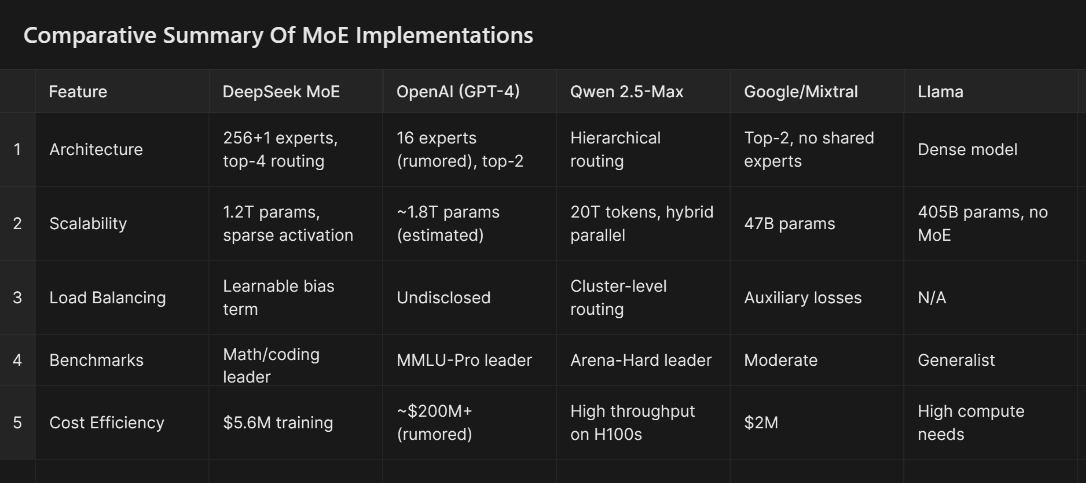
The Mixture-of-Experts (MoE) landscape features diverse implementations from leading AI players. Below is a revised comparison including OpenAI, alongside DeepSeek MoE, Google’s Mixtral/GShard, Qwen 2.5-Max, and Meta’s Llama, focusing on architecture, performance, and use cases:
1. DeepSeek MoE
Architecture & Routing
- Experts: 256 routed experts + 1 shared expert per layer, with top-4 activation (8 experts selected, 4 routed for load balancing).
- Load Balancing: Unique learnable bias term in gating, avoiding auxiliary losses.
- Scalability: 1.2T total parameters, ~24B active per token.
- Specialization: Math/coding focus (e.g., AIME 2024: 86.7% vs. GPT-4o’s 79.8%).
Cost: Trained for ~$5.6M (1/50th of OpenAI’s rumored GPT-4 costs).
2. OpenAI’s MoE (GPT-4)
Architecture & Routing
- Experts: Leaked details suggest 16 experts with top-2 routing, likely split by modality (text, code, vision).
- Load Balancing: Undisclosed, but speculated to use auxiliary losses + dynamic capacity allocation.
- Scalability: Estimated ~1.8T total parameters (55B active per token).
Performance
- Dominates MMLU-Pro (90.2%) and LiveCodeBench (78.5%) but lags behind DeepSeek in math (AIME: 79.8%).
- Multimodal: Integrates DALL·E 3 and TTS for unified text/image/audio processing.
Cost: Training costs are rumored at ~$200M+, requiring massive Azure clusters.
3. Qwen 2.5-Max
Architecture & Routing
- Experts: Hierarchical routing (cluster → intra-cluster) for 64–256 experts.
- Scalability: 20T training tokens, hybrid parallelism for NVIDIA H100s.
- Benchmarks: Tops Arena-Hard (86.1%) and LiveCodeBench (80.3%), matching GPT-4o in MMLU-Pro.
Key Feature: OpenAI-API compatibility for seamless integration.
4. Google’s MoE (Mixtral 8x7B)
Architecture & Routing
- Experts: 8 experts (7B params each) with top-2 activation, no shared experts.
- Scalability: Limited to 47B total params, struggles with multilingual tasks.
- Cost: Open-source and lightweight (~$2M training cost).
5. Llama (Meta)
Architecture: Dense model (405B params), no MoE. Performance: Outperformed by MoE models in reasoning but excels in general text tasks.
Key Takeaways
- DeepSeek MoE: Best for cost-sensitive math/coding tasks but lacks OpenAI’s multimodal depth.
- OpenAI (GPT-4): Multimodal leader with closed architecture and high costs.
- Qwen 2.5-Max: Balances performance and API flexibility but requires heavy infrastructure.
- Google/Mixtral: Open-source and lightweight but with limited scalability.
- Llama: General-purpose workhorse, overshadowed by MoE efficiency.