
Article · AI in Banking
Digital Mobile Payment Solutions - USA
I'm planning to evaluate various mobile payment solutions, recognizing the vast array of options available, many of which are tailored to specific countries and local currencies.
Dato Arif Siddiqui · 21 Jul 2024
I'm planning to evaluate various mobile payment solutions, recognizing the vast array of options available, many of which are tailored to specific countries and local currencies. To provide a thorough analysis, I've decided to write a series of articles, each focusing on a different country. In each piece, I will explore 2 to 6 leading applications specific to that country's market. This article will cover the USA market.
In my analysis, I've applied seven different criteria to evaluate these payment solutions effectively. I invite you to suggest any additional criteria you think should be included or propose changes to the format of the evaluation. Your feedback is invaluable as it will help refine the content to better serve readers' needs and enhance their understanding of mobile payment landscapes.
Revolutionize Mobile Payment Solutions
In today's fast-paced digital world, mobile payment apps have revolutionized how we handle transactions, making it quicker and more convenient than ever before. Whether you're shopping online, splitting a dinner bill, or paying for a coffee, mobile payment apps provide a seamless experience that eliminates the need for cash or physical cards. This article explores the top six mobile payment apps in the USA—Apple Pay, Google Pay, PayPal, Venmo, Cash App, and Zelle. We selected these apps based on their transaction volumes and diverse functionalities, which have made them the go-to choices for millions of users.
Why We Selected These Six Apps
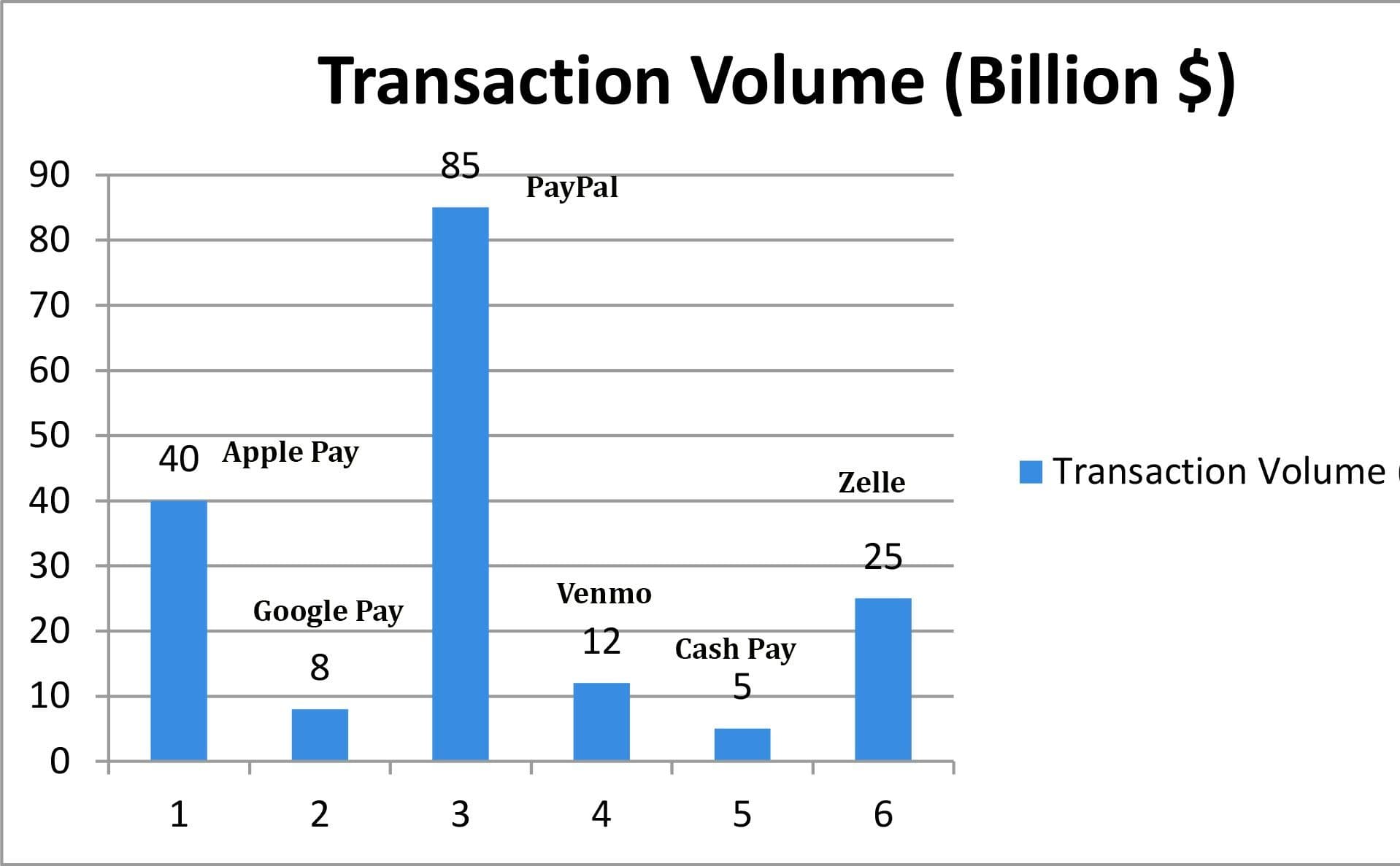
Transaction Volumes: The selected apps are recognized not only for their popularity but also for their significant transaction volumes. These volumes reflect the trust and reliance users place on these platforms for their daily transactions. Apple Pay and Google Pay, integrated into the ecosystem of their respective smartphone platforms, see millions of transactions every day. PayPal, a pioneer in digital payments, continues to lead with substantial transaction volumes globally. Venmo and Cash App have captured the younger audience with their social payment features and ease of use, contributing to high transaction numbers. Zelle, integrated with major US banks, facilitates instant transfers between bank accounts, driving its transaction volumes.
Functionality: Each app offers unique functionalities that cater to different user needs. Apple Pay and Google Pay provide contactless payments, loyalty card storage, and integration with other services within their ecosystems. PayPal is widely accepted for online purchases and offers features like buyer protection. Venmo adds a social aspect to payments, allowing users to share and comment on transactions. Cash App combines payment services with investment opportunities, such as buying stocks and Bitcoin. Zelle, directly linked with bank accounts, ensures fast and secure bank-to-bank transfers without additional accounts or apps.
Size of transaction volume:
Criteria for Evaluation
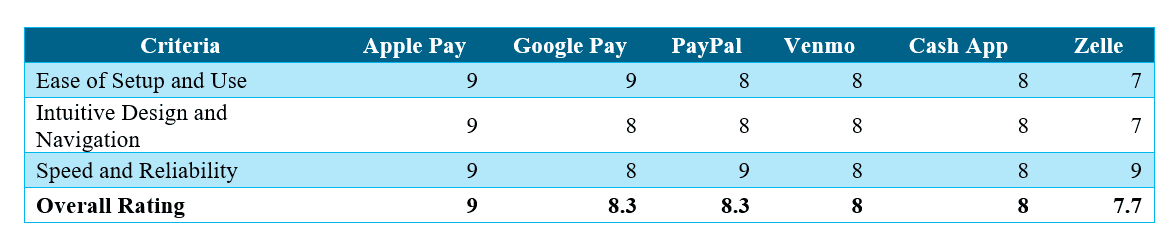
1. User Interface and Experience:
- Ease of setup and use
- Intuitive design and navigation
- Speed and reliability of transactions
2. Security Features:
- Encryption and data protection measures
- Fraud detection and prevention mechanisms
- User authentication methods (biometrics, PINs, etc.)
3. Compatibility and Integration:
- Device and platform compatibility (iOS, Android, web)
- Integration with other apps and services (e.g., loyalty programs, banking apps)
- Availability of APIs for developers
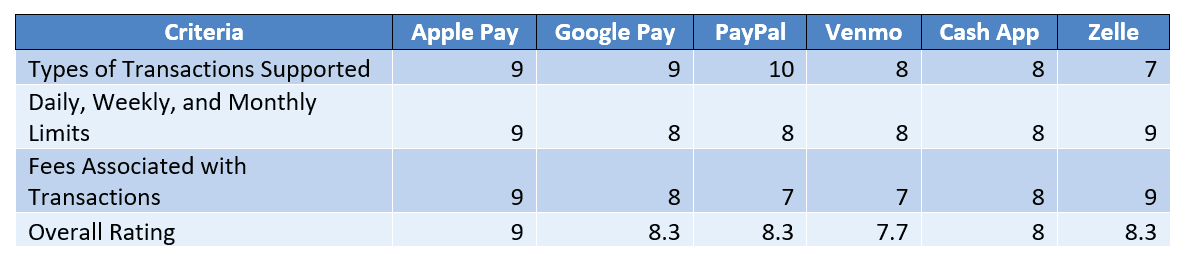
4. Transaction Types and Limits:
- Types of transactions supported (peer-to-peer, in-store, online)
- Daily, weekly, and monthly transaction limits
- Fees associated with different types of transactions
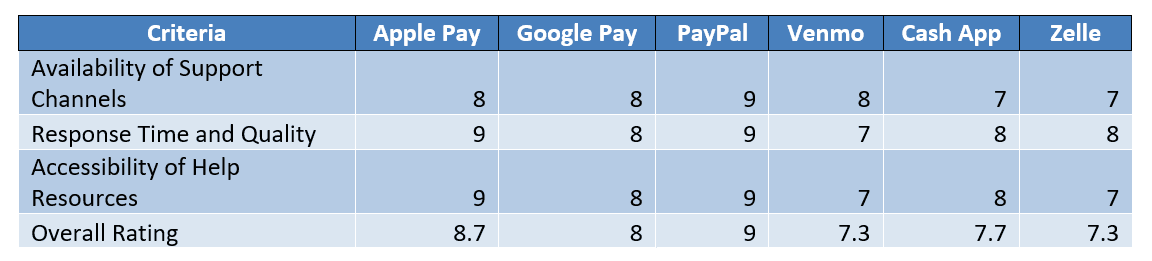
5. Customer Support:
- Availability of customer support channels (phone, email, chat)
- Response time and quality of support
- Accessibility of help resources and FAQs
6. Additional Features:
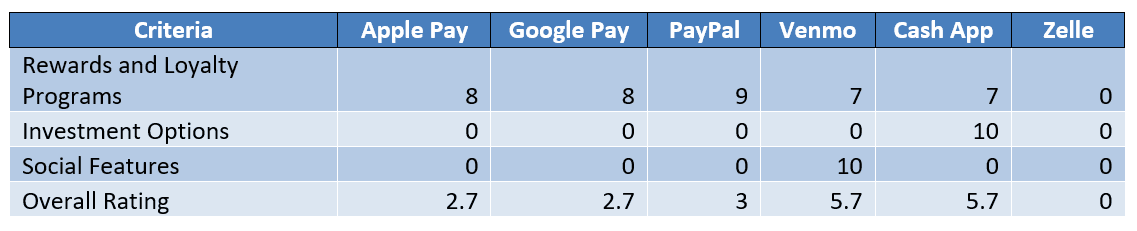
- Rewards and loyalty programs
- Investment options (e.g., stock trading, cryptocurrency)
- Social features (e.g., transaction sharing, commenting)
7. Fee Structure:
- Transparency: Clarity and accessibility of information regarding fees. Predictability of costs for regular transactions.
- Competitiveness: Comparison of fee rates with those of other mobile payment services. Value offered relative to fees charged.
- Variety of Fee-Free Services: Availability of significant fee-free options (e.g., standard transfers, certain types of transactions). Thresholds for free services (like amount limits before fees apply).
By evaluating these mobile payment apps across these criteria, we aim to provide a comprehensive overview of their strengths and weaknesses, helping users make informed decisions about which app best suits their needs.
Compression; a table evaluating the "User Interface and Experience" of the top six mobile payment apps, with ratings from 1 to 10.
2- Security Features

3- Compatibility and Integration:

4- Transaction Types and Limits
5- Customer Support:
6 -Addition Feature:
7. Fee Structure
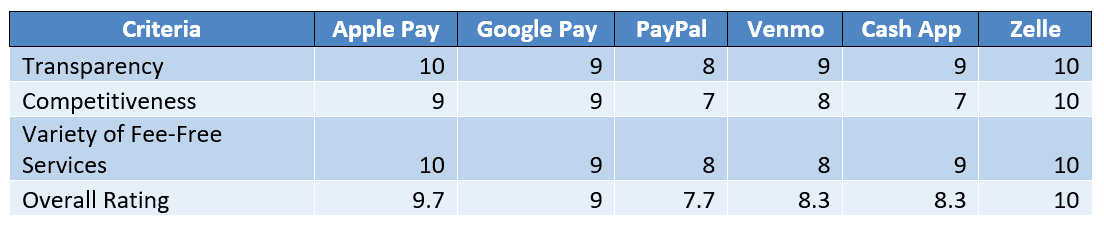
(Note: Zelle is available in 2000 Banks, and completely free)
Venmo is known for its social features that differentiate it from other mobile payment apps. These features are designed to blend financial transactions with social interactions, making it popular especially among younger users. Here's an overview of Venmo's social features:
Social Feed: Venmo has a feed where users can see their friends' transactions (with their permission). This transparency adds a social networking aspect to the app, where users can like and comment on each other's payments.
Emoji Customization: Transactions can be customized with emojis, making the process of sending money more fun and expressive. This can help users denote the purpose of the payment, like pizza for dinner or a taxi ride, in a visually engaging way.
Friend List: Venmo allows users to add and keep track of friends, which simplifies sending and requesting money. This feature is integrated with Facebook and your phone’s contacts, making it easier to connect with people you know.
Privacy Settings: Users can control the privacy of their transactions, choosing to make them visible to the public, their friends, or keeping them private. This flexibility allows users to engage socially at their comfort level.
Group Payments: Venmo supports splitting bills among friends directly in the app, which is useful for shared expenses like meals, rent, or trip costs.
Reminders: The app allows users to send reminders for payments, which is handy for recurring payments among friends, like monthly shared subscriptions or recurring bills.
As we delve into the digital era, the significance of mobile payment apps in the United States continues to skyrocket, driven by consumer demand for convenience, security, and speed. Apps like Apple Pay, Google Pay, PayPal, Venmo, Cash App, and Zelle are not merely tools for financial transactions; they are reshaping how we interact with money in our daily lives. Each app offers unique features that cater to diverse user preferences—whether it’s the social interaction of Venmo, the investment opportunities of Cash App, or the seamless integration of Apple Pay with iOS devices.
These platforms are more than just payment solutions; they are a gateway to a fully digitized financial ecosystem. They encourage less reliance on physical wallets and are pivotal in the push towards a cashless society. As these apps evolve, they will continue to integrate more features, enhance security measures, and expand their user bases. The future of financial transactions is here, and it is digital, driven by the apps that have become essential in our smartphones and, by extension, our lives.