Article · AI in Banking
Best AI for Coding, Math, and Multimodal Tasks, Enterprise AI Showdown, and Academic Research AI Tools
Kimi 1.5 (Moonshot AI) vs. DeepSeek R1 vs. Gemini vs. ChatGPT 4.5 (OpenAI) vs. Qwen 2.5 (Alibaba),
Dato Arif Siddiqui · 22 Apr 2025
Kimi 1.5 (Moonshot AI) vs. DeepSeek R1 vs. Gemini vs. ChatGPT 4.5 (OpenAI) vs. Qwen 2.5 (Alibaba),
The artificial intelligence landscape is undergoing a seismic shift, with cutting-edge language models rivaling human expertise in reasoning, coding, and creative tasks. As organizations race to adopt AI, the challenge lies no longer in accessing technology but in navigating an increasingly crowded field of specialized models, each promising a unique advantage. From cost-free coding tutors to trillion-parameter multimodal giants, today’s AI ecosystem demands precision tool selection to unlock competitive edges.
This article dissects five leading AI systems redefining industry standards in 2024: Kimi 1.5 (Moonshot AI), DeepSeek R1, ChatGPT 4.5 (OpenAI), Qwen 2.5 (Alibaba), and Google Gemini Advanced. Through a granular 10-point functionality analysis, we compare their technical architectures, benchmark performance, and real-world applications, revealing critical insights for developers, enterprises, and researchers.
Why does this matter? The era of “one-size-fits-all” AI has ended. Kimi 1.5’s reinforcement learning-powered math dominance matters little to teams needing Google Workspace integration, just as Gemini’s 1 M-token video analysis holds limited value for open-source advocates. By examining core competencies—from Kimi’s free academic toolkit to DeepSeek’s coding virtuosity and Qwen’s modular SLMs—we provide a strategic roadmap for aligning AI capabilities with operational needs.
Beyond feature lists, this analysis explores emerging trends: the rise of ethical auditing in open-source models, MoE architectures slashing cloud costs, and enterprise-grade safety transforming regulated industries. Whether optimizing R&D budgets or scaling global content operations, understanding these distinctions separates tactical experimentation from transformative AI deployment.
The future belongs to organizations that wield AI not as magic but as precision instruments—this is your guide to sharpening the edge.
1. Kimi 1.5 (Moonshot AI)
Best-in-Class Features:
- 128k-Token Reasoning with RL Optimization Uses reinforcement learning to explore diverse reasoning paths in long-context tasks (e.g., 1,500-page documents). Achieves 96.2% accuracy on MATH-500 via partial trajectory reuse for efficient CoT reasoning.
- Cost-Free Accessibility Unlimited free access via web/API, outperforming paid models like ChatGPT 4.5 in math/coding tasks.
- Multimodal Document Analysis Processes 50+ file types (PDFs, spreadsheets) and integrates web search for real-time data synthesis.
- Chinese Language Dominance Scores 91.7% on CLUEWSC (Chinese language understanding), surpassing most open-source models.
Ideal Use Cases:
- Academic Research: Analyze multi-chapter papers, extract formulas, and generate summaries.
- Legal/Financial Document Review: Batch-process contracts or earnings reports with pinpoint accuracy.
- Coding Education: Debug student code with step-by-step RL-guided explanations.
- Localized AI for China: Deploy cost-free technical assistants for Mandarin-speaking users.
2. DeepSeek R1
Best-in-Class Features:
- Mixture-of-Experts (MoE) Efficiency Activates only 10% of its 671B parameters, enabling faster, cheaper inference than dense models.
- Coding Prowess 98th percentile on HumanEval with advanced features like reverse row logic and memory optimization.
- Transparent Reasoning UI displays full chain-of-thought steps for debugging, unlike ChatGPT’s "black-box" responses.
- Open-Source Flexibility Apache 2.0 license allows commercial customization (e.g., fine-tuning for proprietary codebases).
Ideal Use Cases:
- Software Development: Generate feature-rich code, refactor legacy systems, or optimize algorithms.
- Quantitative Finance: Solve stochastic calculus problems with MoE-accelerated precision.
- AI Safety Research: Audit reasoning processes via visible CoT outputs.
- Budget-Conscious Enterprises: Deploy via API ($0.002/1k tokens) for high-volume technical tasks.
3. ChatGPT 4.5 (OpenAI)
Best-in-Class Features:
- General-Purpose Versatility Balanced performance across creative, technical, and conversational tasks (1.8T dense parameters).
- DALL·E 3 & SVG Integration generates images, diagrams, and vector graphics natively within chat.
- Enterprise-Grade Tooling Function calling API, custom GPTs, and SOC 2 compliance for regulated industries.
- "EQ"-Optimized Interactions Context-aware responses for therapy, negotiation, or customer support scenarios.
Ideal Use Cases:
- Content Marketing: Produce SEO-optimized articles, social media posts, and branded visuals.
- Customer Service: Deploy multilingual chatbots with emotional intelligence.
- Prototyping: Brainstorm product ideas with integrated mockups/SVG flowcharts.
- Education: Create interactive learning modules with text/image explanations.
4. Qwen 2.5 (Alibaba)
Best-in-Class Features:
- Open-Source Specialization Modular models (Math, Coder, VL) trained on 20T tokens, including 5.5T code tokens.
- Tool-Integrated Reasoning (TIR) Hybrid CoT/PoT logic with external API calls for tasks like real-time data fetching.
- Cost-Efficient SLMs 7B parameter coding model outperforms 34B competitors in LiveCodeBench (62.5% accuracy).
- Multilingual Support Fluent in 29 languages, including Arabic and Japanese, with minimal performance drop.
Ideal Use Cases:
- Academic Benchmarking: Reproduce SOTA results via fully open weights/data.
- Emerging Markets: Deploy lightweight SLMs for low-resource languages.
- RPA Automation: Integrate TIR with tools like Zapier for workflow automation.
- GPU-Constrained Environments: Run 7B/14B models on consumer-grade hardware.
5. Google Gemini Advanced
Best-in-Class Features:
- 1M-Token Multimodal Context Analyzes 30k-line codebases, 1,500-page manuscripts, or 3-hour videos (Veo 2 integration).
- Google Ecosystem Synergy Native Workspace integration (e.g., summarize Meet transcripts, build Sheets macros).
- "Deep Research" Mode Synthesizes data from 100+ sources in real time, cited with hyperlinks.
- Applied Math Strength Solves optimization problems using real-world datasets (e.g., supply chain logistics).
Ideal Use Cases:
- Enterprise Knowledge Management: Index internal wikis, emails, and code in a unified AI workspace.
- Video Production: Script, storyboard, and edit footage via Veo 2 prompts.
- Scientific Research: Cross-analyze papers, datasets, and microscopy images.
- Global Teams: Translate documents between 40+ languages with cultural nuance.
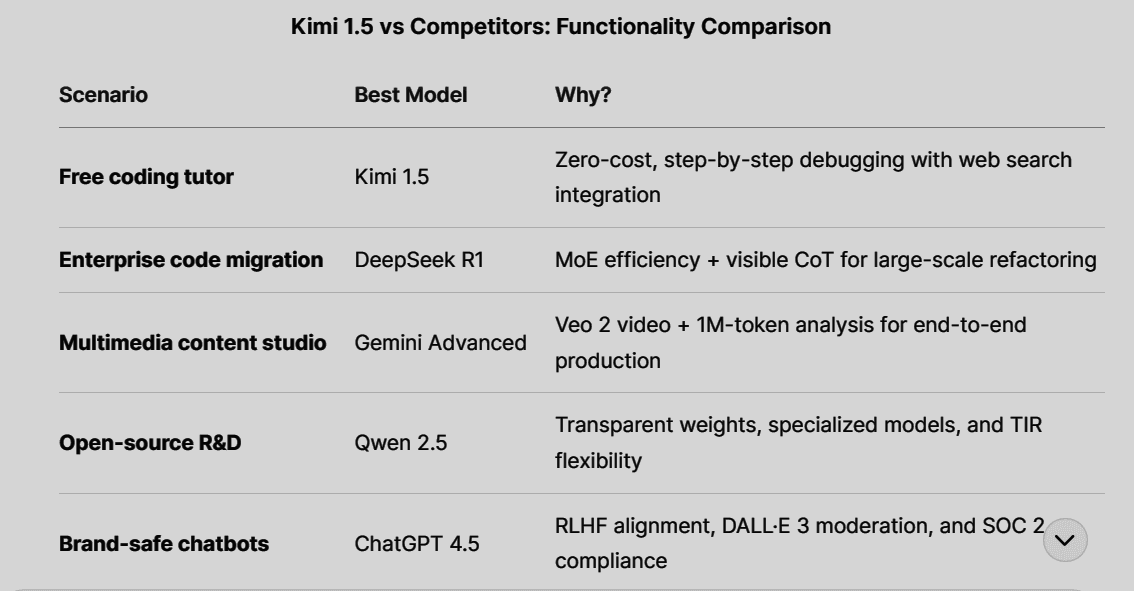
Head-to-Head Recommendations
Future Outlook
- Kimi 1.5: Expected to expand into video reasoning using RL-driven frame analysis.
- Gemini Advanced: Likely to integrate Project Astra for real-time AR/VR workflows.
- Qwen 2.5: Community-driven fine-tuning may yield domain-specific models (e.g., Qwen-Legal).
- DeepSeek R1: MoE architecture could pioneer energy-efficient datacenter deployments.
- ChatGPT 4.5: "Memory" feature for personalized long-term user interactions.
Each model carves a unique niche: Kimi for frugal precision, DeepSeek for coding purists, Qwen for open-source adopters, ChatGPT for generalists, and Gemini for Google-centric ecosystems. Tailor your choice to operational priorities—cost, scalability, or specialization.
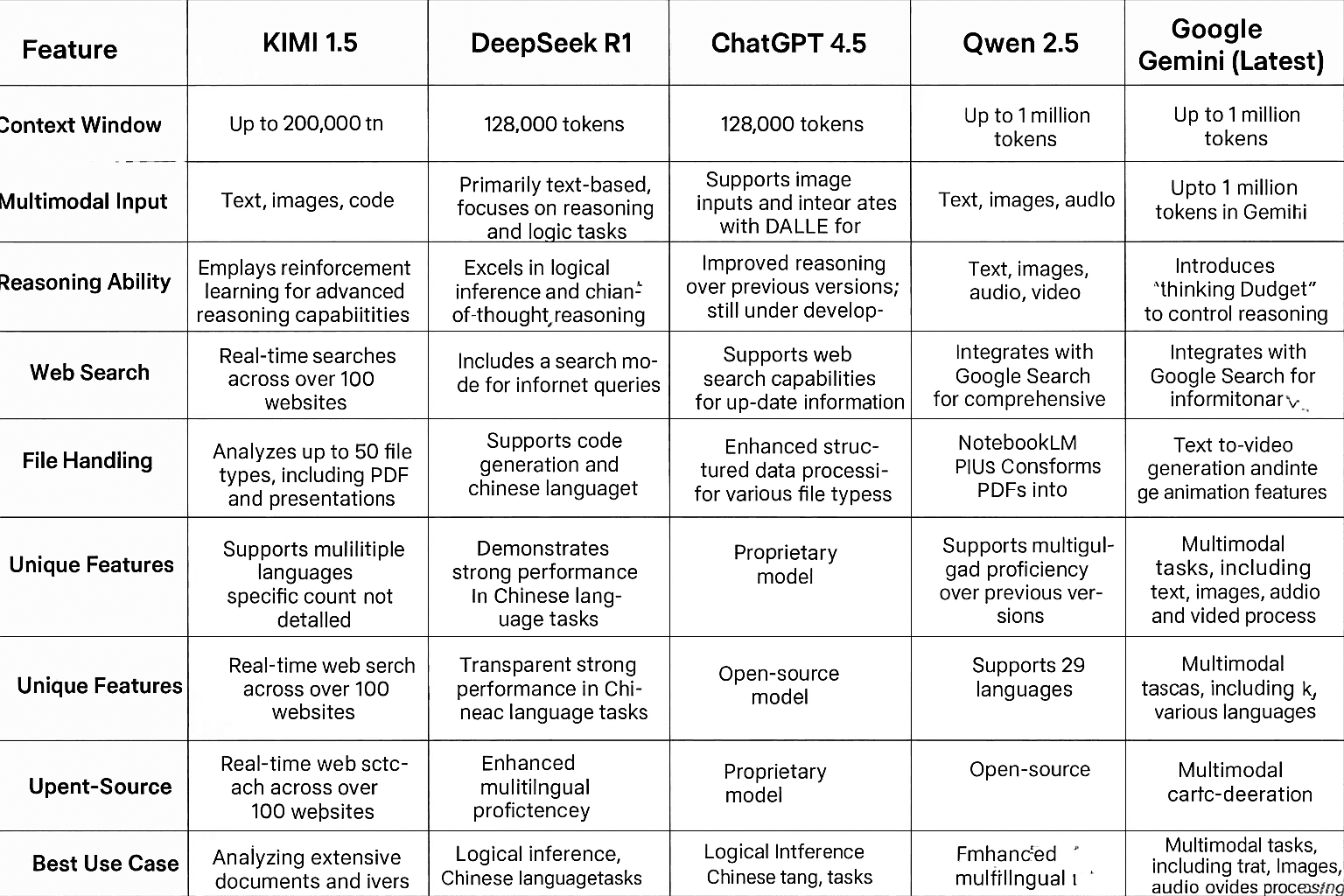
Functionality comparison between Kimi 1.5, DeepSeek R1, ChatGPT 4.5, Qwen 2.5, and Google Gemini Advanced (2025 versions), synthesized from the provided search results:
1. Reasoning Capabilities
Kimi 1.5
Uses reinforcement learning (RL) with 128k-token context scaling and online mirror descent optimization to explore diverse reasoning paths. Excels in long-chain-of-thought (CoT) tasks like math (96.2% on MATH 500) and code (94% on Codeforces), outperforming OpenAI O1 and Claude 3.5 in structured problem-solving 112.
DeepSeek R1
Optimized for technical reasoning via Mixture-of-Experts (MoE) architecture, achieving 97.3% on MATH-500 and 98th percentile on HumanEval. Focuses on efficiency but struggles with multimodal reasoning 612.
ChatGPT 4.5
A generalist model prioritizes broad knowledge over step-by-step logic. Lacks explicit CoT reasoning but improves "EQ" for intuitive problem-solving. Underperforms in math (74.6% MATH-500) compared to specialized models 39.
Qwen 2.5
Specialized models (Qwen2.5-Math, Qwen2.5-Coder) use Tool-Integrated Reasoning (TIR) and PoT methods. The 72B Math variant surpasses GPT-4o in math benchmarks (MATH 80+), while Qwen-Max (MoE) leads in LiveCodeBench 410.
Google Gemini Advanced
Excels in multimodal reasoning with 1 M-token context for analyzing 1,500-page documents. Features "Deep Research" for real-time source synthesis but lacks Kimi’s RL-driven CoT precision 11.
2. Coding Proficiency
Kimi 1.5
Scores 94% on Codeforces and 62.5% on LiveCodeBench v5, matching OpenAI O1. Generates modular code but struggles with UI polish 112.
DeepSeek R1
Dominates with 98th percentile on HumanEval, offering feature-rich implementations (e.g., reverse row logic in games). Preferred for advanced coding tasks 612.
ChatGPT 4.5
Balances simplicity and functionality, ideal for beginner-friendly code generation. Supports API tool calling but lags behind specialized models in complex tasks 39.
Qwen 2.5-Coder
Trained on 5.5T code tokens, its 7B variant outperforms larger models. Integrates with vLLM for OpenAI-compatible API deployment 410.
Gemini Advanced
Analyzes 30k-line codebases, debugs errors, and optimizes performance. Excels in Google ecosystem integration but lacks DeepSeek’s coding depth 11.
3. Mathematical Problem-Solving
Model MATH-500 Score Key Strengths
Kimi 1.5 96.2% RL-driven long-context optimization
DeepSeek R1 97.3% MoE efficiency for quantitative tasks
Qwen2.5-Math 80 %+ CoT/PoT/TIR hybrid reasoning
ChatGPT 4.5 74.6% Generalist approach, weaker in precision
Gemini Advanced N/A Focused on applied math via data analysis
4. Vision and Multimodal Capabilities
- Kimi 1.5: Joint text-vision training achieves 74.9% on MathVista, excelling in chart interpretation 1.
- DeepSeek R1: Limited multimodal support; struggles with image-based text extraction 12.
- ChatGPT 4.5: Accepts image inputs and generates SVG/DALL·E art but lacks advanced visual reasoning 3.
- Qwen2.5-VL: Open-source 72B model with enhanced image comprehension, though less polished than Gemini 4.
- Gemini Advanced: Leader in multimodal workflows (text, image, video via Veo 2) with 1M-token context for large-scale analysis 11.
5. Context Window and Efficiency
Model Context Window Efficiency Features
Kimi 1.5 128k tokens Partial rollouts reuse prior trajectories
DeepSeek R1 128k tokens MoE activates only 10% of the 671B params
ChatGPT 4.5 128k tokens Dense architecture (1.8T params)
Qwen2.5 128k tokens 8k-token generation, optimized for SLMs
Gemini Advanced 1M tokens Processes 1,500 pages or 30k code lines
6. Speed and Responsiveness
- Kimi 1.5: Generates responses instantly but lags in complex coding tasks 12.
- DeepSeek R1: Optimized for speed but slower in image analysis 12.
- ChatGPT 4.5: Slower due to size but prioritizes conversational fluidity 3.
- Qwen2.5-Turbo: API model balances speed and cost for enterprise use 4.
- Gemini Advanced: Real-time "Deep Research" with rapid source synthesis 11.
7. Accessibility and Cost
- Kimi 1.5: Free with unlimited use; API access via application 112.
- DeepSeek R1: Open-source; $0.002/1k tokens for API 6.
- ChatGPT 4.5: Paid tiers (Plus/Pro/Enterprise) 9.
- Qwen2.5: Apache 2.0 license for most models; API via Alibaba Cloud 4.
- Gemini Advanced: $0 HKD trial, then subscription with 2TB Google One storage 11.
8. Specialized Features
Model Standout Features
Kimi 1.5 50-file batch processing, web search integration
DeepSeek R1 Visible chain-of-thought UI for debugging
ChatGPT 4.5 DALL·E image generation, function calling API
Qwen2.5-Max 20T-token pretraining, MoE architecture
Gemini Advanced Veo 2 video generation, Google Workspace integration
9. Multilingual Support
- Kimi 1.5: Strong in Chinese (91.7% CLUEWSC) and English.
- DeepSeek R1: Focused on Chinese/English technical NLP.
- Qwen2.5: 29 languages, including Arabic/Japanese.
- Gemini Advanced: 40+ languages with real-time translation.
- ChatGPT 4.5: Broad but less optimized for non-English tasks.
10. Safety and Ethics
- Kimi 1.5: No disclosed safety protocols; data stored in China.
- DeepSeek R1: Criticized for censorship and data privacy risks.
- ChatGPT 4.5: RLHF-aligned with published safety frameworks.
- Qwen2.5: Community-driven open-source audits.
- Gemini Advanced: Complies with EU AI Act; Google’s transparency reports.
Kimi 1.5 leads in cost-free technical reasoning, while DeepSeek R1 excels in coding efficiency. ChatGPT 4.5 remains the generalist choice, Qwen 2.5 dominates open-source specialization, and Gemini Advanced redefines multimodal scalability. For enterprises, Gemini’s ecosystem integration and Kimi’s affordability are compelling, while developers may prefer Qwen’s flexibility or DeepSeek’s coding prowess. Future advancements in reasoning (Kimi) and MoE scaling (Qwen-Max) will further intensify this competition.