
Article · AI in Banking
AI Could Displace Over Half of Banking Jobs
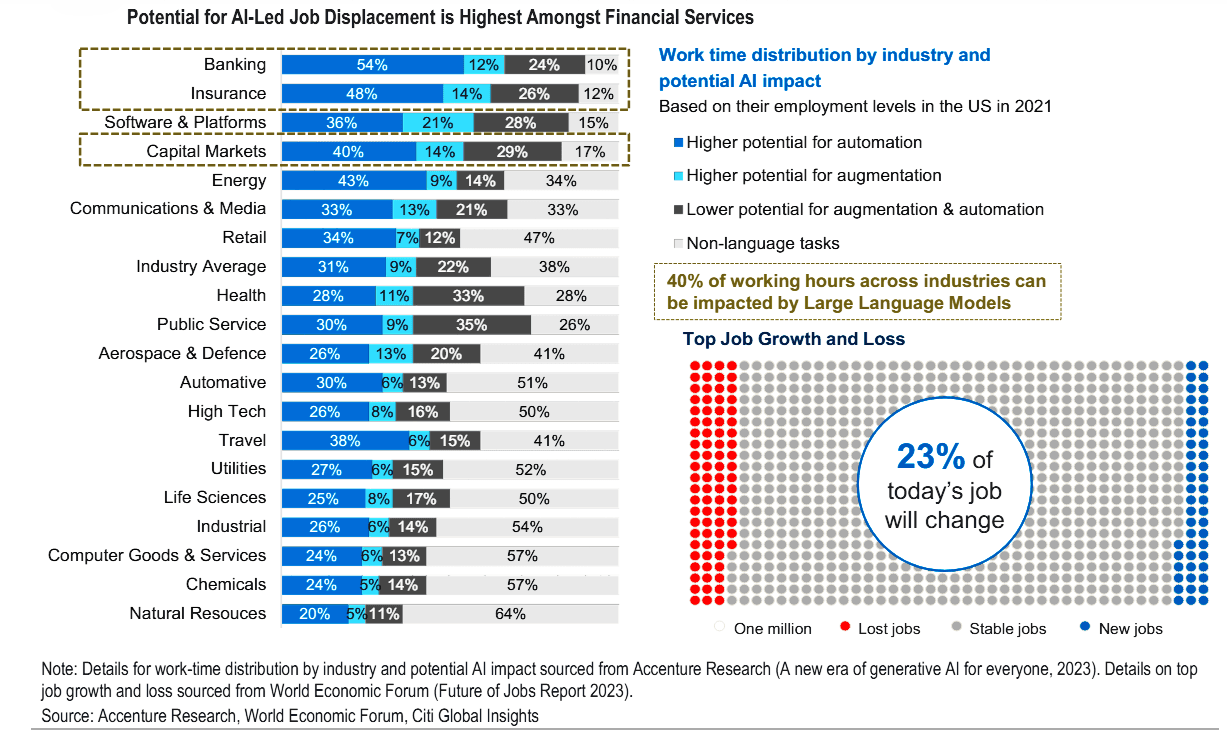
A recent report by Citigroup, the global investment firm, concluded that the banking industry will be significantly impacted by AI, with 54% of roles at risk of AI-led job displacement.
Dato Arif Siddiqui · 23 Jun 2024
A recent report by Citigroup, the global investment firm, concluded that the banking industry will be significantly impacted by AI, with 54% of roles at risk of AI-led job displacement. Additionally, another 12% of banking jobs could potentially be augmented by AI (read the full report).
Citigroup's latest findings highlight that 54% of jobs across banking have a high potential to be automated. An additional 12% of roles could be enhanced with the technology. Over the past year, the world’s largest banks have been increasingly experimenting with AI, motivated by the promise of boosting staff productivity and cutting costs. The report suggests that AI could add $170 billion to the banking industry’s revenues by 2028.
Citigroup plans to enable its 40,000 coders to experiment with various AI technologies. The company has already utilized generative AI, which can produce sentences, essays, or poetry based on user prompts, to quickly review hundreds of pages of regulatory proposals. "Our focus now is to take it from the lab to the factory floor," Citigroup’s Chief Executive Officer Jane Fraser said at the company’s digital money symposium. Fraser added that the banking giant is also exploring AI for custom investment recommendations for wealth clients and enhancing its cybersecurity offerings.
Other major banks are also integrating AI into their operations. JPMorgan Chase & Co. is actively recruiting AI talent, and CEO Jamie Dimon believes the technology could reduce the workweek to just 3.5 days. Deutsche Bank AG is using AI to scan wealthy client portfolios, while ING Groep NV is screening for potential defaulters.
Shameek Kundu, former Group Chief Data Officer at Standard Chartered Bank, mentioned that the biggest new development will be the growth of non-human customers. AI agents will exist in finance by 2030, possibly earlier. Clients may have AI agents and bots before banks do, challenging the traditional control banks have had.
Based on findings from Citi TTS survey, the potential incremental net profit from AI adoption in global banking could be around $170 billion in the next five years, representing a 9% increase over baseline 2028 profit estimates.
According to Accenture, nearly two-thirds of all work in banking and insurance has a high potential for AI-driven automation or augmentation, significantly higher than the overall economy average of 40%. The World Economic Forum predicts that nearly a quarter of all jobs globally will change in the next five years.
A 2023 study by Harvard Business School and Boston Consulting Group suggests that while all employees benefit from AI tools (such as GPT-4), those scoring below average in tasks showed a 43% improvement, while those scoring above average improved by 17%. This indicates that AI tools could help reduce performance disparities.
Generative AI “has the potential to revolutionize the banking industry and improve profitability,” said David Griffiths, Citigroup’s Chief Technology Officer, in a statement accompanying the report. “At Citi, we’re focused on implementing AI in a safe and responsible way to amplify the power of Citi and our people.”
Even if AI replaces some roles across the industry, Citigroup noted that this might not lead to a reduction in headcount. Financial firms will likely need to hire AI managers and AI-focused compliance officers to ensure the technology's use aligns with regulations. Citigroup cited the example of human tellers, whose numbers increased between the 1970s and mid-2000s even after the introduction of automated teller machines.
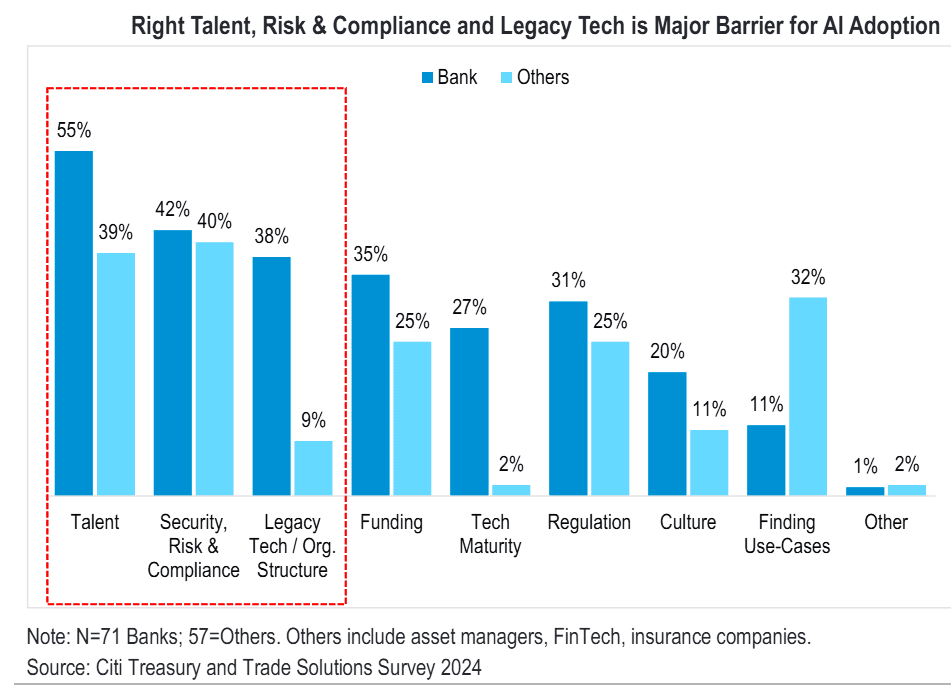
Technological innovation and resulting disruptions fundamentally alter the workforce mix over time. The further integration of AI into finance will accelerate this transformation. In the Citi TTS client survey, 55% of responding banks cited the lack of availability of the right AI talent as a primary barrier in their AI journey, followed by risk and compliance (42%) and legacy technology (38%). Therefore, it is essential to train the existing workforce to be flexible and adaptable.
source: CitiBank report
As most organizations struggle to find the right AI talent, many are looking to balance the demand-supply gap by upskilling, reskilling, and redeploying talent internally or within the industry. A recent McKinsey & Company survey highlights that 56% of its sample are likely to hire GenAI talent internally, compared to 30% who would hire externally. The biggest source of AI talent for banks is still other banks.
How Will AI Be Used in Finance?
For many years, AI, or more specifically ML, has been used in finance on structured data and for quantitative tasks. Today, AI is primarily used in finance for risk and pricing. GenAI will expand use cases to new areas. In the short to medium term, the biggest impact at incumbent financial institutions is expected to be on internal tasks and productivity improvements rather than the creation of new products. Incumbents will focus on improvements in areas such as software and coding, transaction monitoring and compliance, and more. Many bank functions such as credit underwriting, algorithmic trading, portfolio construction, and transaction monitoring already utilize AI/deep learning applications.
GenAI will create new opportunities
Beyond productivity improvements, some of the more blue-sky work—newer products and services, bots using tokenized money, and decentralized AI—will likely take time to build and roll out to market. Autonomous AI agents could turbocharge existing business models and commercial relationships, leading to the creation of new ones. Will AI agents drive the adoption of digitally native money tokens and lead to another stage in the disruption of financial services? This is quite possible by 2030, However, the exact timing of large-scale usage of AI agents remains unclear. Business models need to adapt, regulations need to be introduced or updated, client behavior and employee skills need to evolve. The time lag between the invention and industrialization of a technology can be significant. In the case of financial services, there are additional challenges due to heavy regulation. Changes to how finance handles code and software, or search and summarization, are likely in 2024-25.
Existing ML/AI use cases in compliance and risk management will be GenAI augmented. Core finance functions such as risk analysis and underwriting will also be changed, as will investment research and portfolio management, albeit more slowly.