
Article · AI in Banking
Advanced AI Segmentation in Banking From Static Buckets to Real-Time Decisions
Banks have used customer segments for decades, but many of those segments are still built on labels like age, income, balance, and ZIP code.
Dato Arif Siddiqui · 17 Feb 2026
1) The problem with old segmentation
Banks have used customer segments for decades, but many of those segments are still built on labels like age, income, balance, and ZIP code. These labels are easy to create, but they miss what matters most: behavior and timing. Two customers can look the same on paper and still need very different things. One may be stable, while the other is stressed. One may want speed, while the other wants guidance. When segments cannot capture those differences, the bank’s offers and messages feel generic and often arrive at the wrong time.
That “wrong time” is not a small issue. Timing is valuable. A helpful message at the right moment feels like service. The same message at the wrong moment feels like spam. This is why advanced AI segmentation is no longer just a marketing idea. It is becoming a banking capability that supports growth, cost reduction, customer experience, and risk control at the same time.
2) What advanced AI segmentation really means
Advanced AI segmentation is a shift from describing customers to understanding them and acting in the moment. Instead of asking, “What segment is this customer in?” the modern bank asks, “What is the best safe action right now?” That is the move from static segments to decisioning, and from decisioning to next best experience across channels.
Segmentation still has value, but its role changes. It becomes a layer that helps the bank understand groups and patterns, while the decision engine uses those insights to pick a relevant action. In simple terms, segments become the map, and decisioning becomes the GPS. The map helps you see the territory, but the GPS helps you act at the right time and take the safest route.
3) The business case, with hard numbers
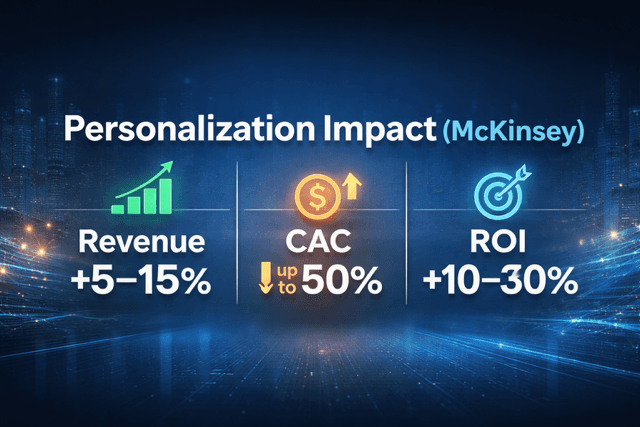
Consultants have been clear that personalization and relevance can create a measurable impact, but only if the bank executes well. McKinsey reports common ranges in which personalization programs can reduce customer acquisition costs by up to 50%, increase revenue by 5% to 15%, and improve marketing ROI by 10% to 30%. These are ranges, not promises, but they show why executives are prioritizing this work. When the bank makes better choices at scale, the outcome shows up in the P&L.
BCG adds a banking-specific push by stating that financial institutions can see very large gains from modern, data-driven marketing and personalization, often described in the range of 20% to 30% revenue lift for top performers. Again, the key point is not the number itself. The key point is that the upside is large enough that banks cannot ignore it, and the winners will be the banks that build the operating model to capture it.
4) Data readiness is the real starting point
Most banks do not struggle because AI is mysterious. They struggle because their data is scattered, slow, and inconsistent. That is why data investment has become a top priority in banking. Deloitte reported that US banks planned to spend more than $5 billion on data initiatives in 2023 alone, which is a strong signal that banks view data readiness as the foundation for modern analytics and AI. The same Deloitte research also highlights a common pain: many bank data users say the data they need is either unavailable or takes too long to retrieve. For real-time decisioning, “too long to retrieve” is the same as “not available.”
This is why advanced segmentation should start with data products, not with a model. A data product is a curated, owned set of data with clear definitions, refresh timing, quality checks, and accountability. When a bank builds data as a product, it becomes far easier to build features, train models, and deliver decisions consistently across channels.
5) The simple maturity model executives understand
A practical way to explain segmentation maturity is to use four levels. The first level is demographic segmentation, which is static and limited.
The second level is behavioral clustering,
where customers are grouped by how they spend,
how they use digital channels, and how they use products.
The third level uses propensity models, such as churn likelihood, product likelihood, or service escalation likelihood, so the bank can rank actions rather than guess. The fourth level is real-time orchestration, where the bank reacts to events and context across channels, while applying policy and compliance constraints.
Many banks are still working between level two and level three. The leading banks are pushing level four, because that is where real-time relevance becomes a customer experience advantage and a cost advantage.
6) Signals matter more than raw data
Advanced segmentation is not about collecting “more data.” It is about building better signals from the data you already have. Signals are features that capture patterns, such as pay rhythm, cash buffer days, spend volatility, subscription pressure, and digital engagement. These signals can be stronger predictors of need than a simple income band. For example, two customers can have the same salary, but one might have a stable cash flow, and the other might have high volatility and bill pressure. A bank that sees those signals can tailor the experience with more care.
Signals can also reflect trust and friction. Customers who face repeated login failures, frequent fraud alerts, or multiple customer service calls in a short period are sending signals that the bank should prioritize service recovery. In a world where customers can switch apps quickly, reducing friction is often a better retention strategy than pushing the next product offer.
7) Where GenAI fits, in a safe and practical way
GenAI is often discussed as if it replaces traditional analytics, but a safer and more practical view is that GenAI translates unstructured data into usable signals. Banks have massive volumes of unstructured text in call notes, chat logs, emails, complaints, surveys, and case notes. GenAI can help extract intent, topics, sentiment, friction signals, and life-event hints from that text. Those extracted tags can then feed the feature layer and help the bank improve segmentation, routing, and next best action decisions.
In this framing, GenAI is a sensor and a translator. It helps the bank listen better and understand better, and then the bank’s decision engine turns that understanding into safe actions. This is a strong way to talk about GenAI in banking because it stays grounded in real workflows, and it respects governance and compliance needs.
8) What great looks like in the real world
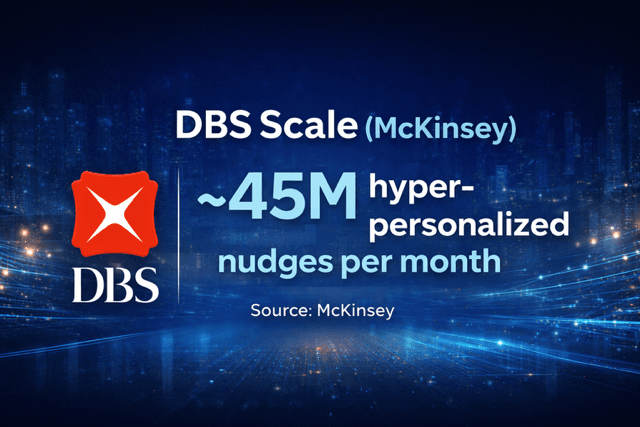
Real bank examples matter because they show this is not a theory exercise. DBS is often cited for its “Next Best Nudge” approach. McKinsey described DBS as running around 45 million hyper-personalized interactions per month through its nudge program. That scale matters because it shows the bank is not only segmenting customers, but also using those segments and propensities to make decisions repeatedly and consistently.
Commonwealth Bank of Australia is another strong reference point because it has publicly discussed using AI at a large scale, including a customer engagement engine that can make tens of millions of decisions daily. This is the difference between “a campaign” and “an operating system.” A campaign is periodic and limited, while an engagement engine is continuous and learns from outcomes.
In the United States, Bank of America’s Erica provides a powerful example of how AI can become an everyday interface that captures intent. Bank of America has shared that Erica has surpassed billions of client interactions and has been adopted by tens of millions of users since its launch. When conversational AI is used well, it becomes a high-quality source of signals about customer needs, confusion, and next steps, and those signals can strengthen segmentation and service design.
9) External benchmark: who leads in AI maturity
It is helpful to include an external benchmark so your article does not feel like an opinion. Evident publishes an AI index for banks and reports rankings based on factors like talent, innovation, leadership, and transparency.
This does not mean other banks are not investing, but it does show which banks are most consistently visible in AI capability signals.
When you cite a benchmark like this, your message becomes stronger: the market is already tracking AI maturity, and leadership is becoming measurable. That pushes the conversation from “do we believe in AI?” to “how fast can we build a durable capability?”
10) Use cases that feel human, not salesy
Many banks first think about cross-sell and upsell, but customers value helpfulness more than offers. One of the best uses of segmentation is financial health nudges that detect early stress and offer support options, fee-avoidance tips, savings nudges, or payment planning. This type of personalization can improve trust while also reducing churn and credit losses.
Another high-value use case is service recovery segmentation. When the bank sees repeated friction—like repeated login failures, multiple calls, or unresolved cases—it should prioritize fixing the problem quickly. Customers often remember how the bank handled a problem more than they remember a good offer. If you segment by friction and route customers to faster resolution, you improve customer experience and reduce operational cost.
Risk-aware personalization is also essential. If a customer shows stress signals, the bank should avoid aggressive credit pushes and instead offer safer support experiences. This reduces conduct risk and protects the bank’s brand. In the small business and wealth segments, AI-driven “next best conversation” support for bankers and relationship managers can improve relevance and productivity by focusing outreach on the right topics at the right time.
11) The operating model that makes it work
The main reason many programs fail is that they start with too many use cases and too little ownership. A better approach is to start with a small number of decision domains, build data products that support those domains, and then scale. A clean operating model has a few key layers: data, features, models, rules, orchestration, and learning. If any of these layers are missing, the system becomes fragile and hard to scale.
A practical starting point is to pick one high-volume journey, such as new account activation or dispute recovery. Build a small set of strong signals, create behavioral clusters, add one or two propensities, and then deploy one action path in a single channel, like mobile or email. The key is to run controlled tests with holdout groups and measure incrementality. Without disciplined measurement, personalization programs can look good but deliver little real lift.
As you scale, monitoring becomes just as important as modeling. Segments change over time, models drift, offer fatigue rises, and fairness issues can appear. Monitoring and governance should be built in as part of the product, not added after problems occur.
12) Governance and compliance: what leaders include
Banking requires safety. Advanced segmentation must include privacy, fairness, explainability, and human override. Privacy means clear purpose limits, fast opt-out handling, and data minimization. Fairness means checking outcomes by group and watching for proxy variables that can create unintended bias. Explainability means the bank can answer, in plain language, why a customer received an offer or message, and the bank can support audits with documentation.
Human override is also important. Context can beat models, especially in sensitive cases. When staff can override a suggested action, the system becomes safer and more trusted internally. Model governance also needs basics like a model register, approvals, monitoring logs, and change control. These controls do not slow innovation when designed well. They make scaling faster because stakeholders trust the system.
13) Metrics executives and boards will respect
If you want executives to fund this work, you must show the right metrics. On the commercial side, measure incremental revenue, margin impact, activation rates, and retention rates. On the service side, measure call deflection, first contact resolution, average handle time, and digital adoption. On the risk side, measure delinquency changes, charge-off changes, fraud loss changes, dispute volumes, and conduct-risk signals. On the trust side, track opt-out rates, message fatigue, and sentiment trends.
Advanced AI segmentation is not about clever math. It is about better banking. It helps customers at the right time, reduces friction, lowers cost, improves growth, and manages risk with more care. Consultants show that personalization can deliver measurable impact, but the winners are the banks that build the data foundation and the operating model to deliver consistent decisions at scale.
The pattern from leading banks is clear: build signals, run decision engines, measure lift with experiments, and scale with governance. If your bank still runs static segments, you are not alone, but the next stage is clear. Move from buckets to decisions. Move from campaigns to journeys. Move from slow refresh cycles to real-time learning. That is how banks win in the AI era.
References (links)
McKinsey – What is personalization? (impact ranges) https://www.mckinsey.com/featured-insights/mckinsey-explainers/what-is-personalization
McKinsey – DBS AI-powered bank / Next Best Nudge https://www.mckinsey.com/about-us/new-at-mckinsey-blog/an-inside-look-at-how-mckinsey-helped-dbs-become-an-ai-powered-bank
Deloitte – Banking data & analytics survey insights ($5B+ planned spend) https://www.deloitte.com/us/en/services/consulting/articles/2024-banking-data-analytics-survey-insights.html
Deloitte – Banking industry outlook (data/AI context) https://www.deloitte.com/us/en/insights/industry/financial-services/financial-services-industry-outlooks/banking-industry-outlook.html
Accenture – Banking trends 2026 https://www.accenture.com/us-en/insights/banking/accenture-banking-trends-2026
BCG – How bank CMOs can do more with less (personalization) https://www.bcg.com/publications/2023/how-bank-cmos-can-do-more-with-less
Evident – 2025 Evident AI Index (bank rankings) https://evidentinsights.com/bankingbrief/heres-the-2025-evident-ai-index/
Bank of America – Erica milestones (AI assistant) https://newsroom.bankofamerica.com/content/newsroom/press-releases/2025/08/a-decade-of-ai-innovation--bofa-s-virtual-assistant-erica-surpas.html