
Article · AI in Banking
10 Mobile App Capabilities Customers Expect, but Banks Still Don’t Deliver
Mobile banking has reached a point where design parity exists, but functional depth does not. Most banking apps look polished, load quickly, and offer basic self-service features, yet few truly help customers manage…
Dato Arif Siddiqui · 26 Jan 2026
Mobile banking has reached a point where design parity exists, but functional depth does not. Most banking apps look polished, load quickly, and offer basic self-service features, yet few truly help customers manage money intelligently. The next phase of digital banking competition will not be won through better screens or more menus, but through smarter functionality embedded into everyday financial decisions.
Customers now expect banking apps to behave less like digital statements and more like financial copilots. They want prediction instead of hindsight, control instead of constraints, and automation instead of manual effort. Fintech’s have raised expectations by delivering real-time insights, virtual controls, and goal-based experiences, while many traditional banks remain anchored to legacy workflows wrapped in modern interfaces.
This article examines the most critical functionality gaps in today’s banking apps and identifies where banks must focus over the next two years to stay competitive. It shifts the discussion from features banks already offer to capabilities customers increasingly demand but rarely receive. The objective is clear: outline how banks can evolve their mobile apps from access tools into intelligent, value-creating financial platforms.
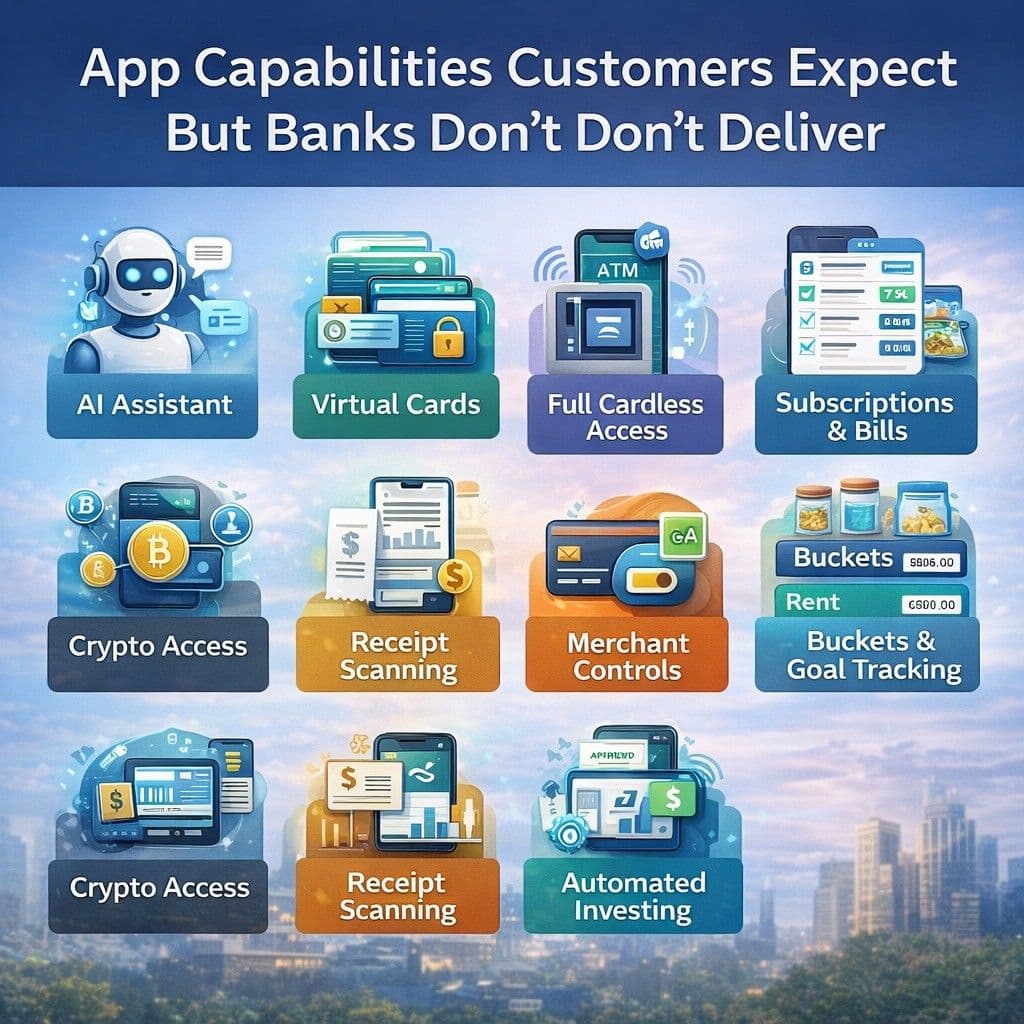
1- An AI-driven financial assistant is the most critical missing capability in banking apps. Most apps show balances and transactions, but fail to explain what will happen next. A true assistant predicts cash shortfalls, flags unusual spending, and suggests actions before problems occur. Bank of America leads here through Erica, which delivers proactive insights at a massive scale. Most banks still operate in a reactive, not predictive, mode.
2- Virtual cards with dynamic CVV and merchant-level numbers are essential for modern digital security, yet most banks still issue a single static card number. This exposes customers to unnecessary fraud risk. Capital One is the clear leader, offering virtual cards tied to specific merchants, with automatic controls and easy management in the app. Average banks still treat this as an add-on rather than a core feature.
3- Full cardless access removes dependence on physical cards and improves resilience. Customers should be able to withdraw cash using a mobile wallet alone. Many banks support limited cardless access, but coverage is inconsistent. Chase stands out due to its wide cardless ATM network and smooth wallet-first experience. Most banks remain tied to legacy ATM workflows.
4- Subscription and bill intelligence help customers understand where money quietly leaks every month. Most banks display recurring charges but do not analyze trends or alert customers when costs increase. Ally Bank performs well by clearly identifying subscriptions and providing clean recurring-expense visibility. Traditional banks largely avoid this space due to data complexity.
5- Live sub-accounts and money buckets are far more powerful than static savings folders. Customers need real-time views showing how spending impacts future goals. Ally Bank again leads by offering dynamic buckets that update continuously. Most banks still treat goal tracking as a static feature with no forecasting logic.
6- Integrated crypto exposure remains rare among traditional banks despite strong customer demand. Many institutions block or ignore crypto entirely. Revolut leads by embedding crypto access directly into the banking experience, allowing users to view and manage digital assets seamlessly. Most U.S. banks stay cautious due to regulatory uncertainty.
7- Receipt and expense intelligence is crucial for freelancers and small businesses, yet underdeveloped in most banking apps. Scanning receipts is common, but intelligent matching and categorization is not. PNC stands out with stronger expense tracking inside its Virtual Wallet ecosystem. Average banks still leave this work to external apps.
8- Merchant-level card controls give customers real power over how their money is used. Instead of freezing an entire card, users should control spending by category, merchant, or time. Capital One excels here with granular, real-time controls. Most banks still offer only basic on/off switches.
9- Automated goal-based investing inside a banking app helps customers grow wealth without friction. Most banks separate deposits and investments, forcing users across platforms. SoFi leads by unifying banking and investing with automated contributions and rebalancing. Traditional banks lag due to product silos.
10- Instant credit inside the app removes branch dependency and reduces friction. Customers expect pre-approved credit offers that can be activated immediately. Chase leads with fast, data-driven decision-making at scale. Many banks still rely on manual or branch-led credit workflows.
Banks should prioritize intelligence over interface during the next two years. Most apps already look modern, but functionality remains shallow. The primary gap is predictive capability. Banks must move from showing historical transactions to forecasting cash flow, identifying risks early, and recommending actions in real time. AI-driven financial guidance should become a default layer, not a premium feature.
The second focus area must be control and security at a granular level. Customers increasingly expect merchant-level card controls, virtual cards, dynamic CVVs, and instant card lifecycle management. Static cards and basic freeze options are no longer sufficient. Enhancing customer-controlled security reduces fraud losses while improving trust and engagement.
Banks should also invest heavily in wallet-first and cardless experiences. Physical cards, branch dependency, and legacy ATM flows slow adoption. Cardless ATM access, instant wallet provisioning, and mobile-only authentication should be treated as core infrastructure, not optional enhancements.
Another critical area is money organization and behavioral finance. Static budgeting tools are outdated. Banks should implement live sub-accounts, goal-based buckets, and real-time forecasting that adjusts as customers spend. This shifts the app from a balance viewer to a daily money management companion.
Subscription and expense intelligence will become a competitive differentiator. Customers want banks to identify recurring charges, flag increases, and surface unnecessary spending automatically. Fintechs already do this well. Traditional banks risk losing relevance if they ignore this insight layer.
Banks must also rethink credit delivery inside the app. Instant, pre-approved credit with transparent terms should replace branch-centric workflows. Faster decision-making improves customer satisfaction and increases product penetration without adding operational cost.
Finally, banks should focus on platform unification. Customers dislike fragmented journeys across banking, investing, and external apps. Seamless integration of deposits, payments, investing, and insights within one experience will define leading apps by 2027.
In summary, the next two years should be about building functionalities in the Mobile Banking App: predictive intelligence, granular control, wallet-first access, real-time money organization, automated insights, instant credit, and unified experiences. Banks that execute here will move from being transactional utilities to trusted financial platforms.
Also read:
https://www.linkedin.com/pulse/mobile-banking-2026-benchmarks-evidence-execution-mohammad-arif-qvyqc
https://www.linkedin.com/pulse/mobile-banking-adoption-usa-vs-europe-asia-mohammad-arif-vfsgc